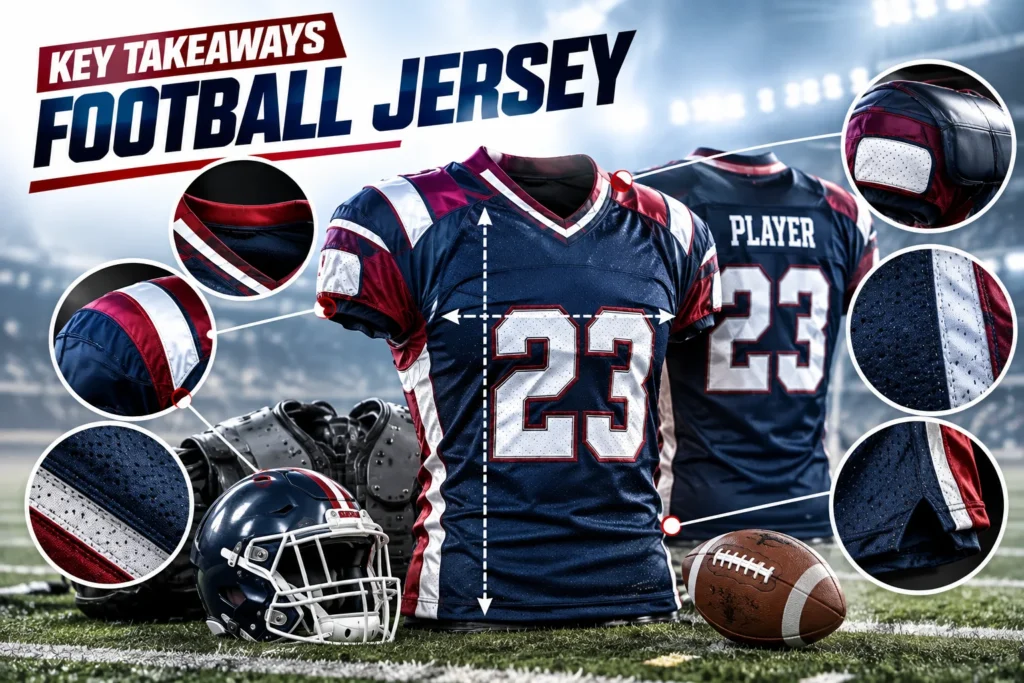
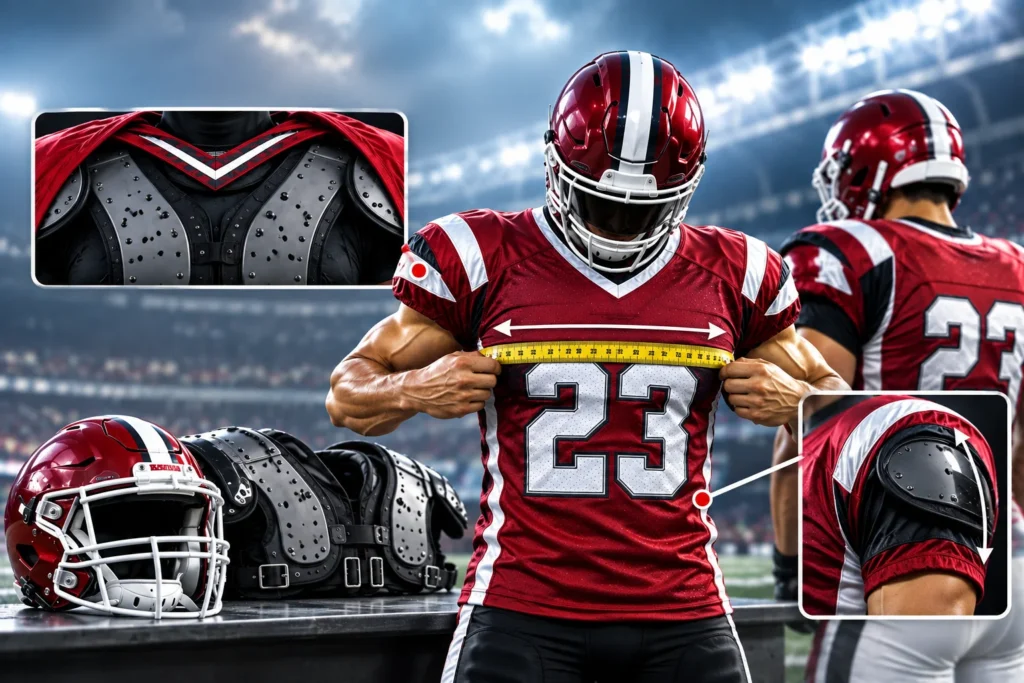
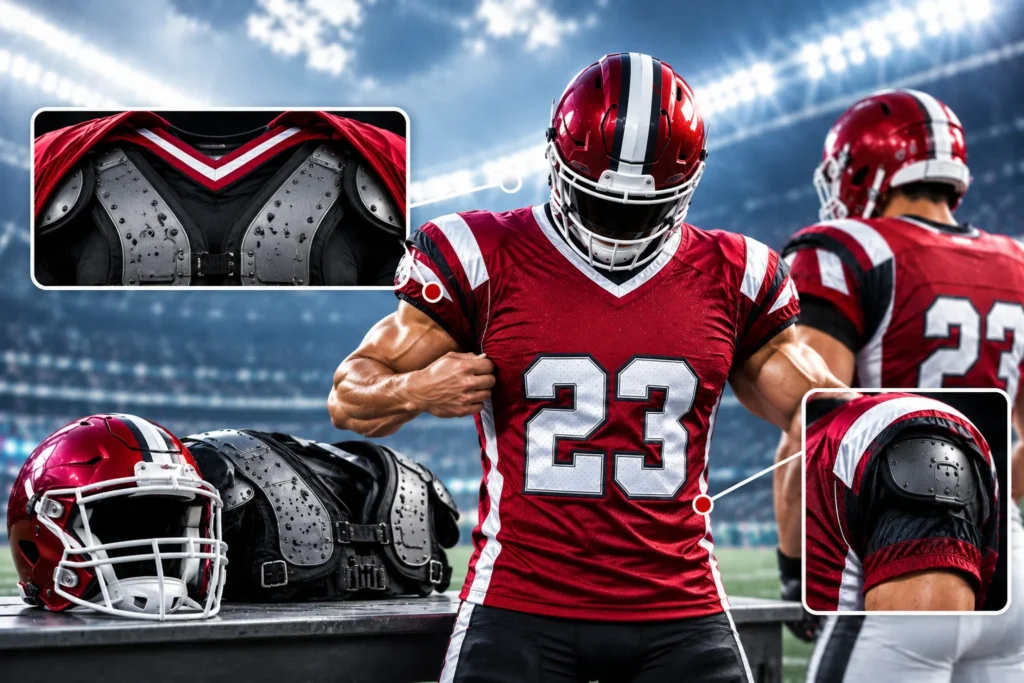
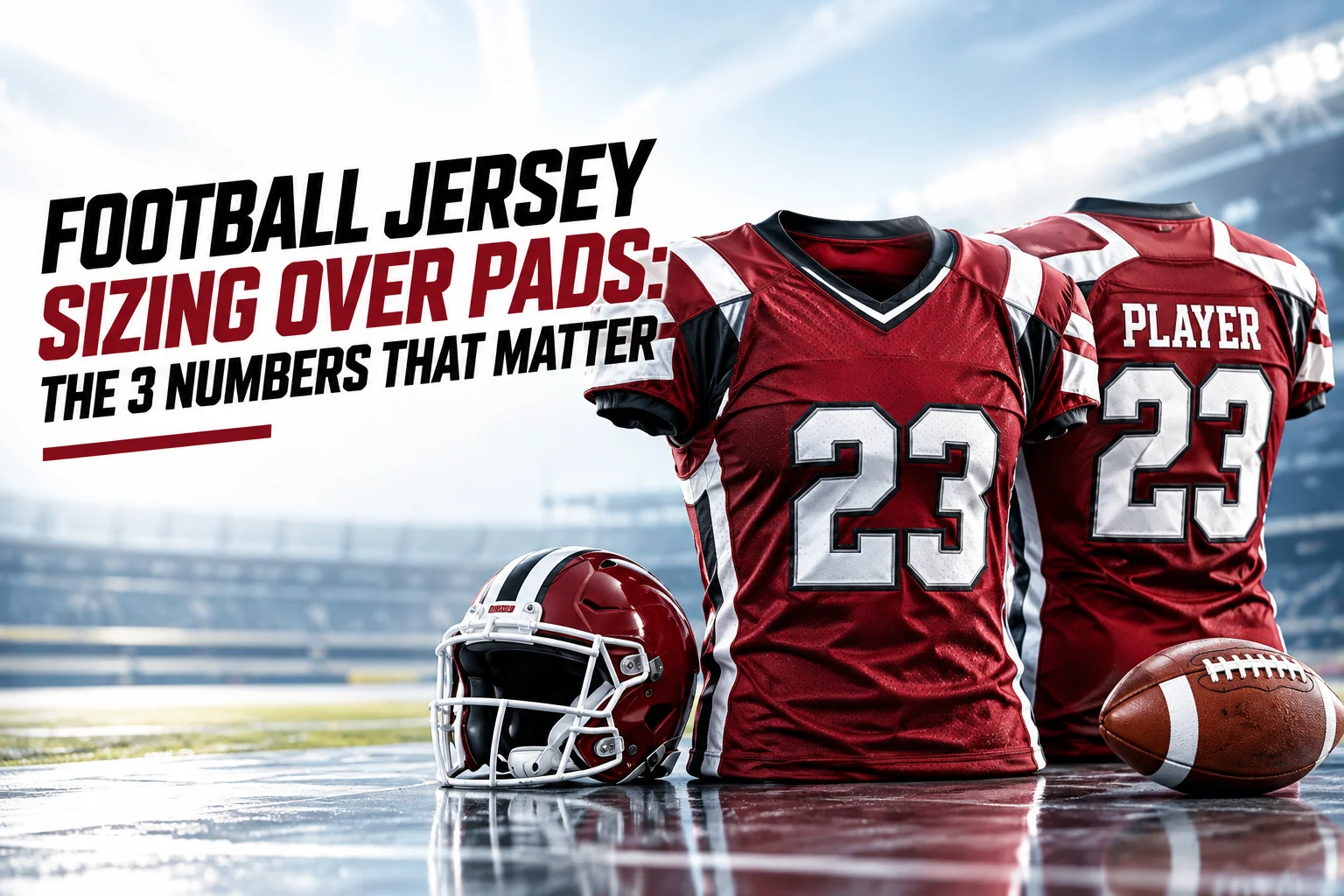
A football jersey isn’t sized to a body, it’s sized to a body wearing several inches of foam and plastic. Get the chest measurement while the shoulder pads are already on, add sleeve length that clears the pad’s arm opening, and add torso length long enough to stay tucked through contact. Those three numbers, taken over the pads a player will actually wear, are what separate a jersey that survives the season from one that needs a mid-season remake.
No other jersey on a roster works this way. A basketball or baseball jersey sizes to skin and a base layer. A football tackle jersey has to clear a full shoulder pad shell and still let a lineman reach and a receiver stretch without the fabric fighting either one.
This walks through why over-pads sizing exists, how to take the three measurements correctly, and where a lineman’s numbers and a skill player’s numbers genuinely diverge.
Every other jersey on a team’s rack sizes to skin and maybe a compression shirt underneath. Football sizes to skin, a compression layer, and then several inches of shoulder pad shell on top of that. That extra bulk sits directly across the chest and shoulders, the same zone that determines whether a jersey clears overhead on a reach or binds on a block.
USA Football’s own equipment-fitting sequence has a program measure and fit the shoulder pads to the athlete first, then check front and back coverage once the pads are on. A jersey ordered before that sequence, sized to a chart built for a bare torso, is guessing at a number the pads haven’t confirmed yet. Order after the pads are fitted and the chest measurement is real, not estimated.
Have the athlete put on the shoulder pads they’ll actually play in before the tape measure comes out. Wrap it around the fullest part of the chest, over the pad shell, roughly level under the arms, and keep it snug without compressing the pads. That number, not a bare-chest figure with inches guessed on top, is what a pattern gets cut to.
Two shoulder pad models at the same labeled size don’t always add the same bulk. A low-profile pad built for a receiver sits closer to the body than a bulkier lineman shell, so two players with identical bare-chest measurements can need two different jersey sizes once their actual pads are on. Sending the over-pads number sidesteps that guesswork entirely.
If pads haven’t been issued for the season, a bare-chest measurement with an estimated allowance is the fallback, not the method. Confirm the actual over-pads number once pads are issued, particularly for any player whose pad model or position changed from last season, and treat the early order as provisional until that confirmation happens.
The sleeve cuff has to pass over the shoulder pad’s arm opening without riding up on a reach. A cuff cut for a bare shoulder rides higher than intended once it’s stretched over a pad edge, which exposes bare skin and pad plastic on exactly the motion, a throw, a catch, a block, where a jersey needs to stay put.
This is a fit detail most bare-chest size charts never account for, since they’re built for a jersey worn without pads underneath at all. Measuring sleeve length with the pads on, arm raised through a full reach, catches the problem before the jersey is cut rather than after it ships.
A jersey that’s short in the body pulls loose from the waistband the moment a player takes contact, and once it’s untucked mid-play it stays that way for the rest of the series. Torso length has to account for the pads adding bulk above the waistband and for the stretch a jersey undergoes across the shoulders during a block or tackle, both of which pull material upward and shorten the effective coverage below.
NFHS’s jersey rules require the jersey to completely cover the shoulder pads and any pad worn above the waist. That’s not only a comfort preference, a jersey that rides up mid-play and stops covering the pads underneath is a compliance problem at the line of scrimmage, not just a distraction. Erring on the longer side of a torso measurement is the cheap insurance against that.
A 230-pound lineman and a 230-pound tight end can need two different jersey sizes, not because one player is bigger, but because their pads and their job on the field are different. Linemen wear bulkier shoulder pads built for repeated direct contact, which adds more chest and shoulder bulk than a lower-profile pad built for a receiver or defensive back. That alone pushes the chest measurement up.
Reach matters just as much. A lineman’s arms extend fully on nearly every snap, punching, blocking, driving through contact, which means both the sleeve and the torso need more working room than a skill player who spends less time at full extension. A receiver or defensive back, by contrast, usually wants the closer cut once pad room is accounted for, since loose fabric is something an opponent can grab.
The practical result for a roster order: don’t size the whole team off one player’s numbers scaled by weight. Take all three measurements, over the actual pads worn, position by position, and expect the offensive and defensive line to run a size or more ahead of skill players at a comparable bodyweight.
Youth shoulder pads are lighter than adult pads, but they still add real bulk across a smaller frame, and youth pad models vary between brands just as much as adult ones do. The same over-pads chest, sleeve, and torso measurements apply, taken with the actual youth pads the player will wear, not scaled down from an adult chart by age or grade alone.
A youth player also grows mid-season more than an adult does. If jerseys are ordered before pads are finalized for a young roster, treat the order as provisional the same way described above, and confirm final numbers once pads are issued rather than guessing forward from a spring measurement.
Flag and 7-on-7 jerseys size off a standard bare-chest measurement, the same way a basketball or baseball jersey does, because there’s no pad volume to build room for. None of the three over-pads measurements above apply. If a program runs tackle at one level and flag or 7-on-7 at another, size each roster on its own terms rather than applying the over-pads method to a build that was never designed to carry it.
The same two-number discipline, chest and length, just without any pad math, is what our basketball jersey sizing guide walks through for a roster with no pad volume to build room for at all.
Three measurements, taken over the pads a player will actually wear, decide whether a football jersey fits: chest width, sleeve length at the cuff, and torso length for tuck-in. Size to a bare-chest chart instead, and the gap shows up mid-season as a remake, not at the fitting table where it’s cheap to fix.
Send those three numbers per player, position noted for anyone running linemen and skill players on the same order, and Rijiz Sports builds the pattern to match, mockup and exact quote back within 24 hours. For the cost side of that same order, see our football jersey pricing breakdown.