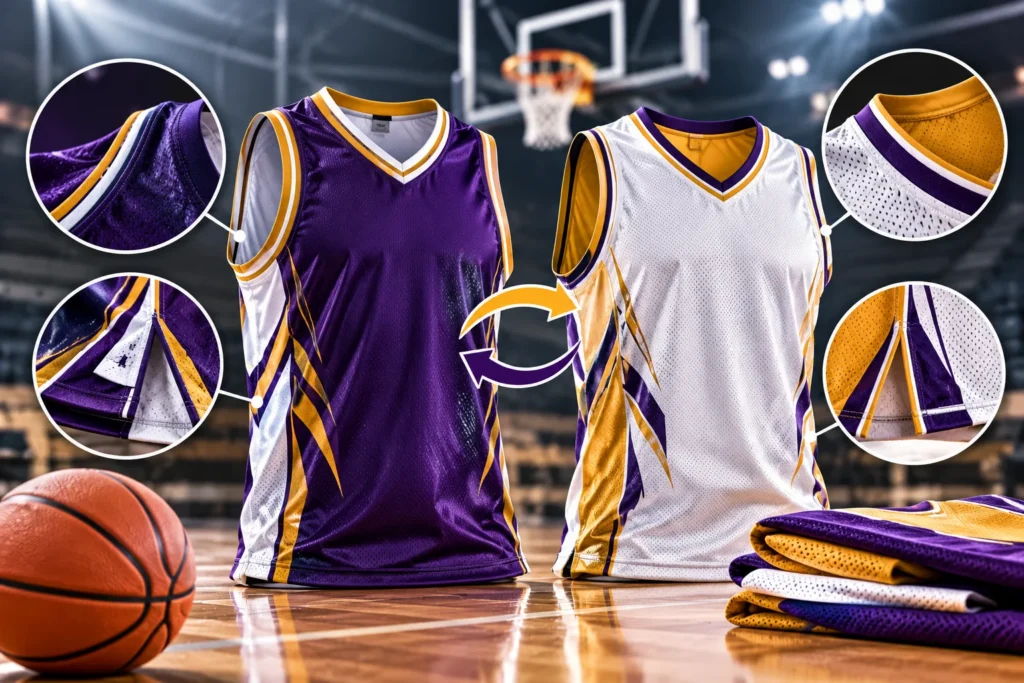
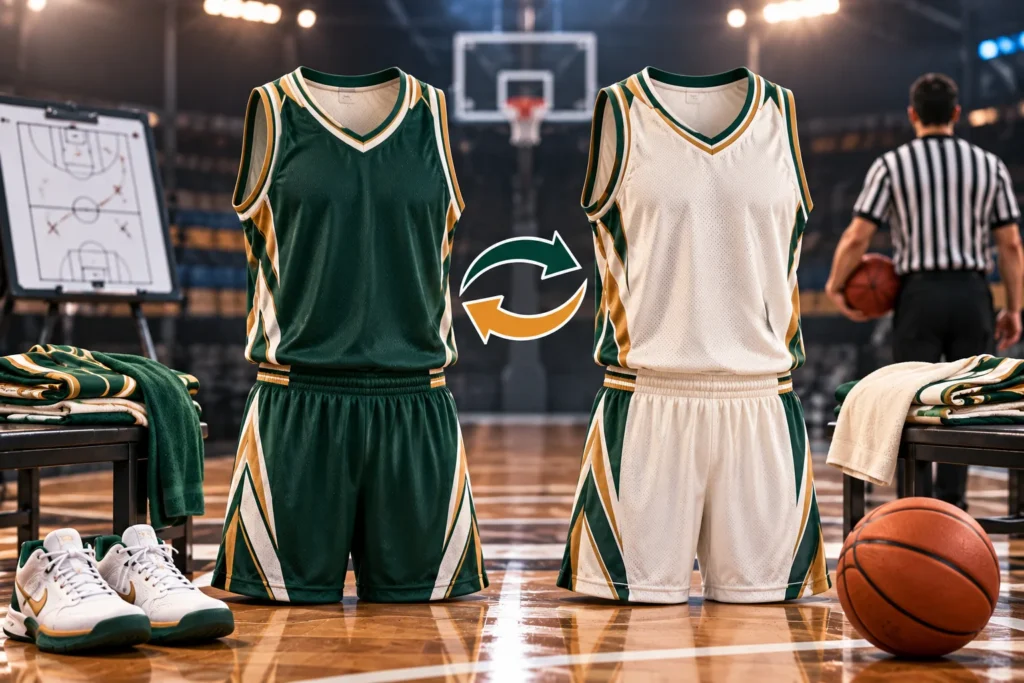
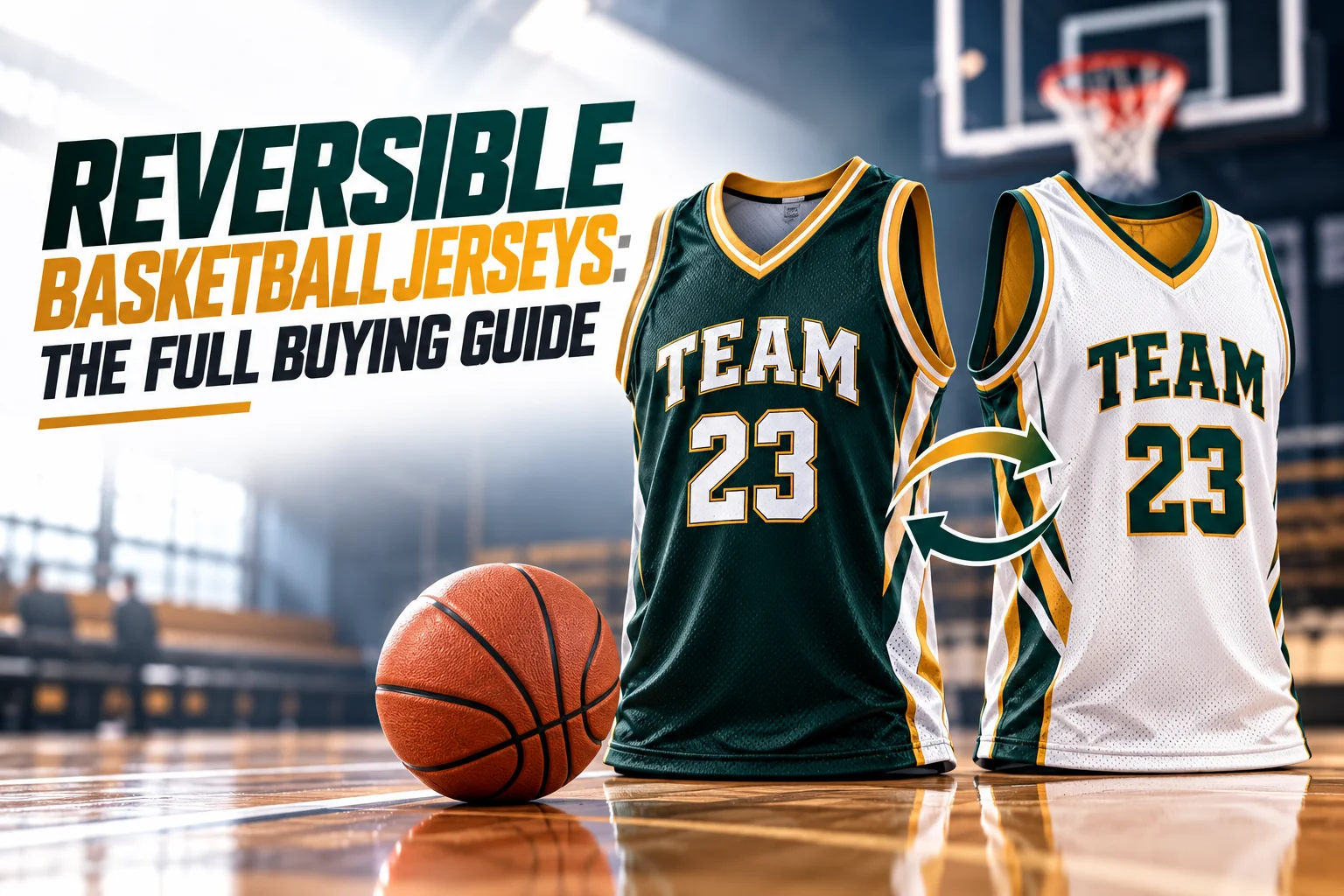
A reversible basketball jersey works when a squad plays multiple games in different colours without packing two full sets, and it’s the wrong build when a roster only ever wears one colourway. The construction is genuinely double the fabric of a single-layer jersey, so the added weight and cost only pay off if the roster actually uses both sides.
That trade-off is the whole decision, and it’s one no basketball jersey buyer should make from a product photo alone. This guide walks through what reversible construction actually is, when it’s worth ordering, how sizing changes with it, and how to keep both colourways looking right through a season.
Everything here is built from the same fabric and construction data our own reversible line ships against, factory-direct, not a generic industry description.
A reversible basketball jersey isn’t a single-layer jersey with a second colour printed on the back. It’s built from two full layers of fabric joined at the seams, each sublimated on its own side, so either colourway can face out. That construction is where the added weight and cost come from, not the number of colours in the design.
On our line, that works out to roughly 260 GSM total fabric weight in a reversible build against 140 GSM for a single-layer sleeveless jersey, close to double. A factory building a reversible jersey is cutting two panels instead of one, joining them at every seam, and decorating both sides, and that extra step shows up in both the weight of the finished garment and the time it takes to build.
Not every reversible construction lands at the same weight. A lighter micro-mesh build, roughly two 120 GSM layers with a thin separator between them, can bring a full reversible kit in under 10 oz against roughly 14 oz for a heavier reversible construction, close to 30% lighter for the same two-sided function. The trade-off is the same either way: more fabric than a single-layer jersey, just less of it in the lighter build.
Reversible pays for itself in a specific situation: a squad playing multiple neutral-site games against different opponents in one weekend or road trip, where the alternative is packing two full sets of jerseys instead of one reversible set. That’s real weight and space saved in a bag, not just a marketing line.
It’s the wrong build for a program that only ever plays in one colourway at home and a simple away alternate that doesn’t need to be the same jersey reversed. Paying for double the fabric and a second decoration pass when the second side never gets worn is money spent on a feature the roster doesn’t use. A standard sleeveless pullover covers that program better and lighter.
The two measurements that matter, chest width and jersey length, are the same for reversible as for any other basketball jersey. What changes is the margin for error. The colour-transition seam on a reversible jersey runs directly through the armhole area, and a size chosen a notch too loose doesn’t just look baggy, it can let that seam gap open under a full reach mid-game, exposing the inside layer at exactly the wrong moment.
Because reversible construction already has less give built into the armhole than a lighter single-layer cut, rounding a size up “to be safe” works against a reversible jersey in a way it doesn’t on a standard one. Measuring the chest width carefully, rather than estimating from a label, matters more here than on any other style in the range.
A reversible jersey isn’t one uniform with a backup colour, it’s two uniforms that both have to clear the same rules on their own. Under the NFHS’s basketball uniform rules, a jersey number can no longer be the same colour as the jersey itself, effective the 2024-25 season, and that requirement doesn’t relax for whichever side happens to be facing out. Each colourway needs its own compliant number colour and contrast, checked separately, not assumed from the other side.
Competitive leagues outside the US high-school system set their own equivalents. FIBA’s rules exist as a separate document from the playing rules, so a program ordering reversible for international or club competition should confirm its specific number-colour and minimum-height requirements before finalising either side’s decoration, not just the primary one.
The general rule for a sublimated jersey (cold wash, inside out, no bleach, air dry or low heat) still applies to reversible, but two layers pressed against each other add a colour-transfer risk a single-layer jersey doesn’t have. Dark and light colourways sitting face to face in a wash load or a tightly packed bag for a full season can transfer trace colour between the two sides over repeated cycles.
Washing reversible jerseys separately from lighter single-layer pieces in the same load, and storing them flat or on a wide hanger rather than folded tightly with one side pressed against the other for weeks between games, protects both colourways for the length of a season instead of just the first few wears.
Reversible only makes sense when a roster genuinely wears both colourways, and the decision comes down to real fabric weight, not a slogan about getting two jerseys for one. Once you know the GSM math, the sizing margin, and the care routine that protects both sides, ordering reversible stops being a guess about whether it’s worth it.
If your season includes multiple neutral-site games in different colours, send your style and roster measurements to our basketball jersey line and get a mockup with an exact quote back within 24 hours. Compare that against what actually drives your price before you commit to a full team order, or start from the Rijiz Sports homepage to see the rest of what runs off the same factory floor.