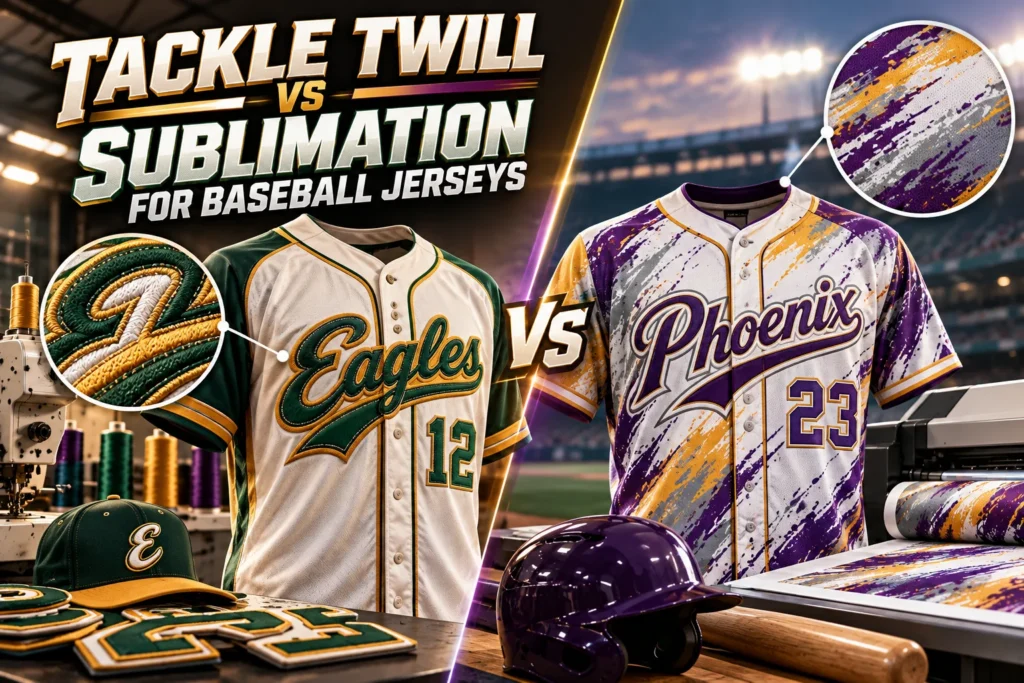
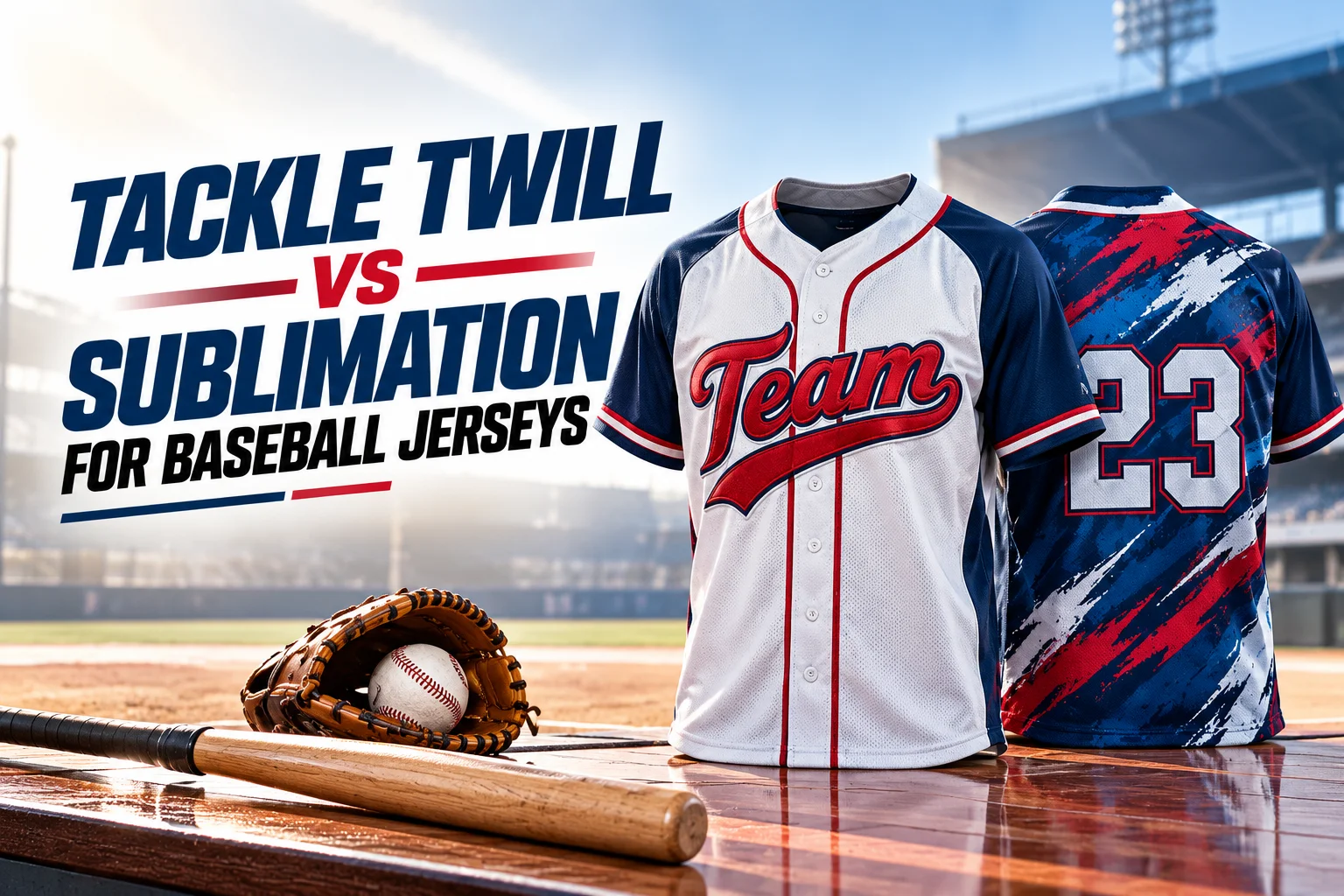
Tackle twill is stitched felt, cut letter by letter and sewn onto the jersey. Sublimation is dye heat-fused directly into the fabric at a flat rate no matter how complex the design gets. That single difference in how the two methods sit on the garment is what drives every other trade-off: cost, timeline, durability, and how the jersey feels by the seventh inning.
This isn’t a one-size answer. A traditional program chasing a stitched, dimensional look pays for it in per-character pricing and stitching time. A team prioritizing full-colour graphics or a tighter production window usually leans sublimated instead. Both run through the same baseball jersey line at Rijiz Sports, cut, decorated, and stitched on one factory floor, so the choice comes down to what your roster actually needs, not which method is “better.”
Below is what actually changes between the two, in the order it matters to someone placing a real order: how each is built, what drives the cost, what slows down a timeline, how each holds up, and what a governing body might require regardless of your budget.
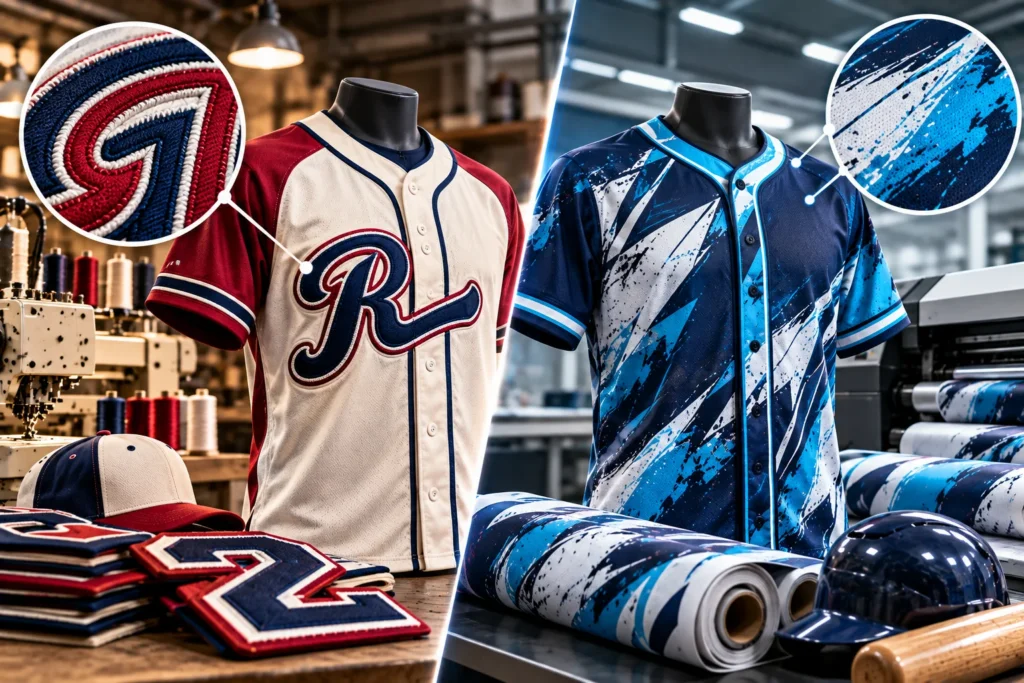
Tackle twill starts as a sheet of polyester felt. Letters and numbers are cut from it, positioned on the jersey, and sewn down around every edge with 40-weight polyester thread at 8 to 10 stitches per inch. What’s left is a raised, dimensional patch that sits slightly proud of the fabric surface, the same construction used on MLB uniforms.
ublimation works the opposite way. Heat fuses dye directly into the polyester fibre at the molecular level, so the graphic becomes part of the fabric instead of sitting on top of it. It works best on white or light-coloured base fabric, and because the ink is inside the fibre rather than printed onto it, the surface stays completely flat.
Neither method is a shortcut version of the other. A team that wants the stitched look of tackle twill on a fully sublimated jersey is describing two different production steps, not one process with a setting to change.
Tackle twill’s cost scales with what you’re actually asking the stitching line to do. Every letter and number is its own cut piece of felt, individually sewn down, so a nine-letter surname and a full three-digit number cost more to produce than “SOX” and a single digit. That’s a real labour difference, not a markup on longer names.
Sublimation doesn’t work that way. Once a design is set up for the heat press, adding a fourth colour, a gradient, or extra graphics doesn’t add a separate production step, so the per-jersey rate stays flat regardless of how detailed the artwork gets. A sponsor logo, pinstripes, and a full-colour mascot cost the same to sublimate as a simple wordmark, because the dye goes in during one pass either way.
That’s the real driver behind why a traditional program with tackle twill names on every player and a youth team running full sublimation end up with different quotes for what looks like a similarly sized order. Send your style, decoration method, and quantity and you’ll get the exact number back, not an estimate built on guesswork.
The letter-by-letter nature of tackle twill also affects how long production takes, not just what it costs. A roster with a handful of short names clears the stitching line quickly. A 30-player roster with long surnames and full first-and-last-name lettering on every jersey means more individual pieces to cut and sew, which adds real time inside the confirmed 15 to 25 day bulk production window.
If your timeline is tight and your roster runs long names, using abbreviated surnames or last-initial-only lettering keeps tackle twill on the table without pushing production toward the back of that window. Sublimation doesn’t carry this constraint, since a longer name in a sublimated design adds no extra stitching step to the production line.
Sublimated colour is dyed into the fibre itself, so it can’t peel, crack, or flake the way a surface-printed graphic can. That holds up well through repeated infield contact and normal washing, since there’s no separate layer sitting on top of the fabric to wear away.
Tackle twill is stitched down rather than glued or printed on, so it resists the fraying and cracking that cheaper heat-transfer letters are prone to. The edge that’s exposed is the stitched perimeter, and while that perimeter is durable under normal wear, a snag on something sharp, a cleat, a dugout rail, catches the raised edge in a way a flat sublimated surface never will. Textile durability testing generally relies on standardized methods, AATCC’s accelerated colorfastness-to-laundering test approximates roughly five home launderings’ worth of colour and abrasion stress in a single 45-minute test, which is the kind of standard behind claims that a decoration method resists fading, rather than a number either method here has separately published.
Neither method is the wrong choice on durability grounds alone. It’s a question of which failure mode you’re trading against: a rare snag risk on stitched edges, or a rare white-fibre exposure if a sublimated surface gets deeply scuffed.
If you’re weighing a traditional stitched roster against a full sublimation build and the deciding factor is your production window or your budget for long names, send your roster size and preferred lettering now. You’ll get an exact number and timeline back within 24 hours, not a range.
Before deciding how small a number can go to save on tackle twill stitching, check what your league actually allows. NFHS’s baseball uniform rules set a back number at a minimum of 8 inches high, in a plain Arabic style, in a solid colour that contrasts with the jersey, with a border no wider than a quarter inch. That floor applies regardless of decoration method, so shrinking a tackle twill number to cut per-character cost isn’t actually available for competitive high school play. Confirm your own league or federation’s requirement if it’s stricter than that baseline.
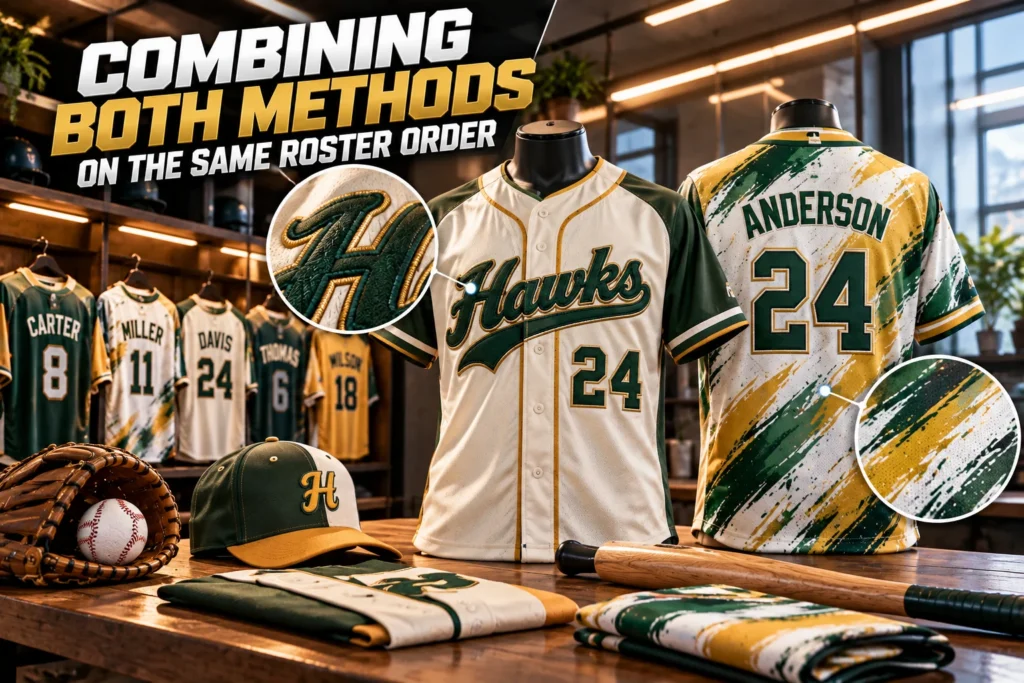
Tackle twill and sublimation aren’t an either-or choice for a single order. A sublimated front wordmark paired with tackle twill names and numbers on the back is a normal combination, not a custom request, since each zone of the jersey can carry its own decoration method within the same production run.
That also means mixed decoration doesn’t complicate MOQ 20. A team ordering some jerseys with sublimated graphics and others with tackle twill lettering, or combining both on every jersey, still just needs the combined order to clear 20 pieces total. A club running Little League, high school varsity, and a travel squad together on one purchase order can mix decoration methods per team without each team clearing the minimum separately.
Sublimated colour is bonded into the fibre and won’t crack or peel, but fabric softener residue dulls its saturation over repeated washes, so skip it. Tackle twill is stitched down rather than glued, which makes it durable under normal washing, but direct heat from an iron can flatten or scorch the felt, so keep the iron off that area specifically rather than avoiding heat on the whole garment.
Both benefit from the same basics either way: cold water, turned inside out, air dried when possible or low heat if machine drying, with dirt and grass stains pre-treated before the wash cycle rather than left for the machine to handle alone.
Tackle twill and sublimation aren’t competing for the same job. One is stitched felt priced by the letter, built for a traditional, dimensional look that can take a real timeline hit on long rosters. The other is dye fused into the fabric at a flat rate, faster to produce and built for detailed, full-colour graphics. Most orders don’t have to pick one exclusively, since the two combine cleanly across different zones of the same jersey.
See the full construction detail on our baseball jersey line, browse the complete baseball uniform range for pants and caps, or send your style, decoration method, and quantity now for an exact quote back within 24 hours.