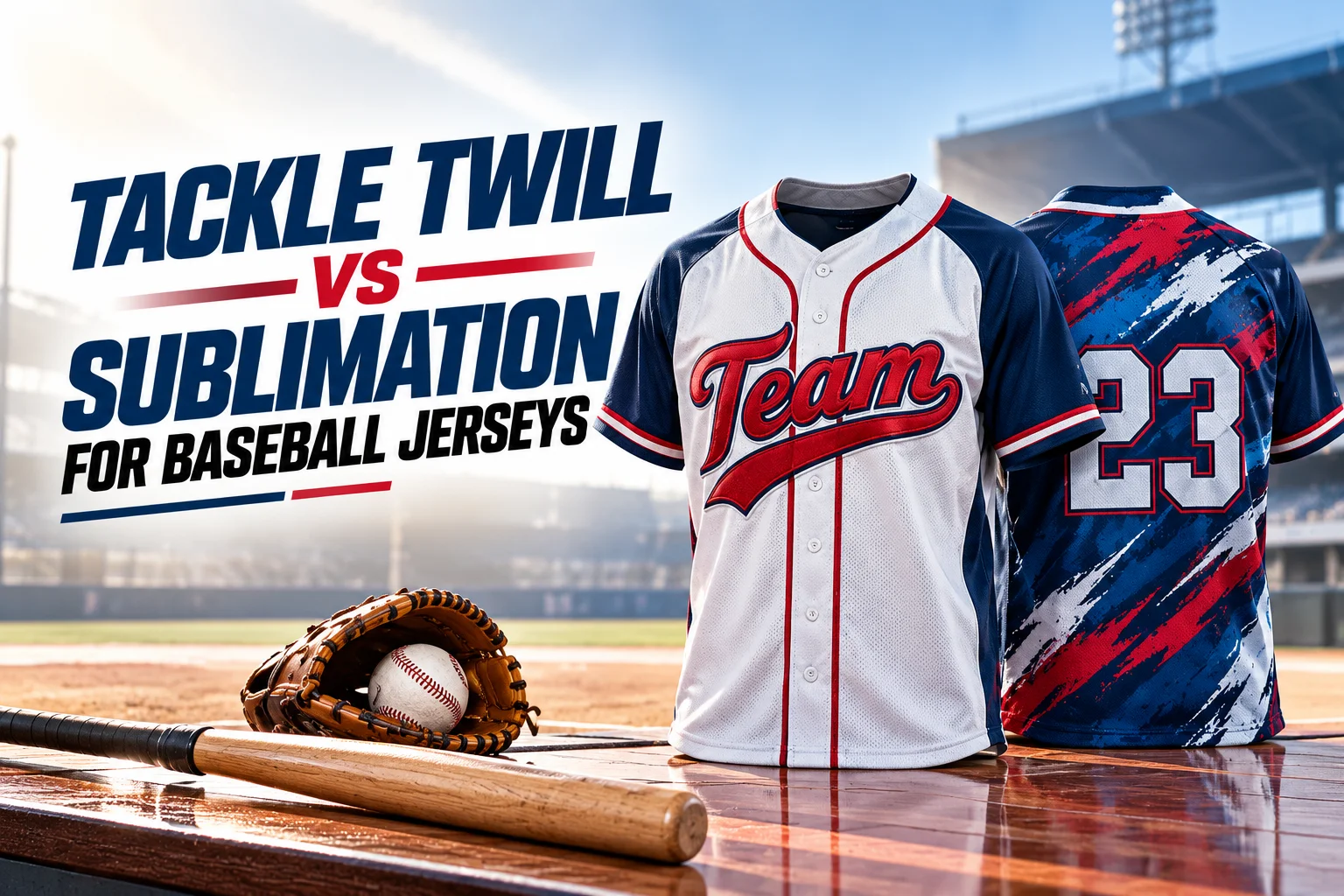
A baseball jersey’s price is set by three things before a factory can quote you: which button style you’re building (full-button, two-button, or pullover), how the design gets applied to the fabric, and how many total pieces the order covers once pants and caps get counted in. Colour count and artwork complexity move that number far less than those three.
A youth league board and a high school program can describe what sounds like the same order and still get two very different numbers back, and the gap almost always traces to one of those three levers rather than a supplier padding a quote. Sorting out which lever actually moved is what turns a confusing number into something you can budget against ahead of the season.
Below, each driver is explained the way it actually prices against our own baseball jersey line, cut and stitched on one factory floor, ending with the exact information a factory needs from you before it can hand back a real number instead of a range.
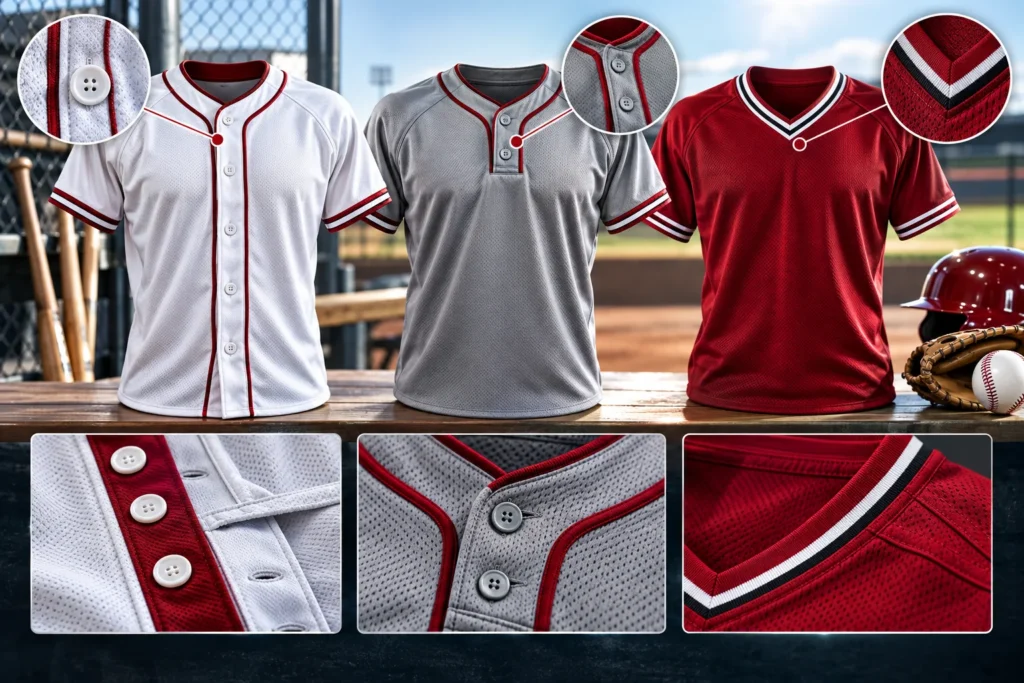
Full-button, two-button, and pullover aren’t three price points on the same jersey. They’re three different fabric-and-construction baselines, and a factory prices whichever one you choose against its own labor and material cost, not against one shared starting number.
A full-button jersey runs on 150 GSM interlock mesh with a double layer of fabric behind the button line, reinforced enough that the buttons pull-test at 15+ pounds before packing. That reinforcement, plus attaching four to six buttons by hand, is real cutting and stitching time that a two-button or pullover jersey never needs. Two-button trades some of that weight for a shorter collar placket and a reinforced collar band, at 135 GSM. Pullover skips the button line entirely, built on 130 GSM performance micro-mesh with a ribbed V-neck, which is also why it’s the cut most often chosen for youth leagues and practice jerseys, where budget usually matters more than the traditional placket look.
None of the buttons on any of these three styles are decorative. NCAA Rule 1-14(c) bans polished metal or glass buttons on a competitive uniform, which is one reason factories default to matte, sew-through buttons rather than offering a shinier option as an upgrade. The rule sets a ceiling on what a button can look like well before it ever becomes a cost question.
Button style sets the baseline; decoration method moves the number from there, and it works on a completely different mechanic than colour count. Sublimation runs one flat rate per jersey regardless of how many colours or how complex the graphic gets, because the design is dyed into the fabric in a single pass. Tackle twill is priced by letter and number count instead, since every character is a piece of stitched felt applied individually, not ink. A roster full of long surnames costs more in tackle twill than the same roster in abbreviations; sublimation’s rate doesn’t move either way.
Which one costs less depends on your roster and your timeline, not a fixed rule, and that trade-off deserves its own full breakdown rather than a paragraph here. See our tackle twill vs. sublimation guide for the complete comparison, including durability and lead time.
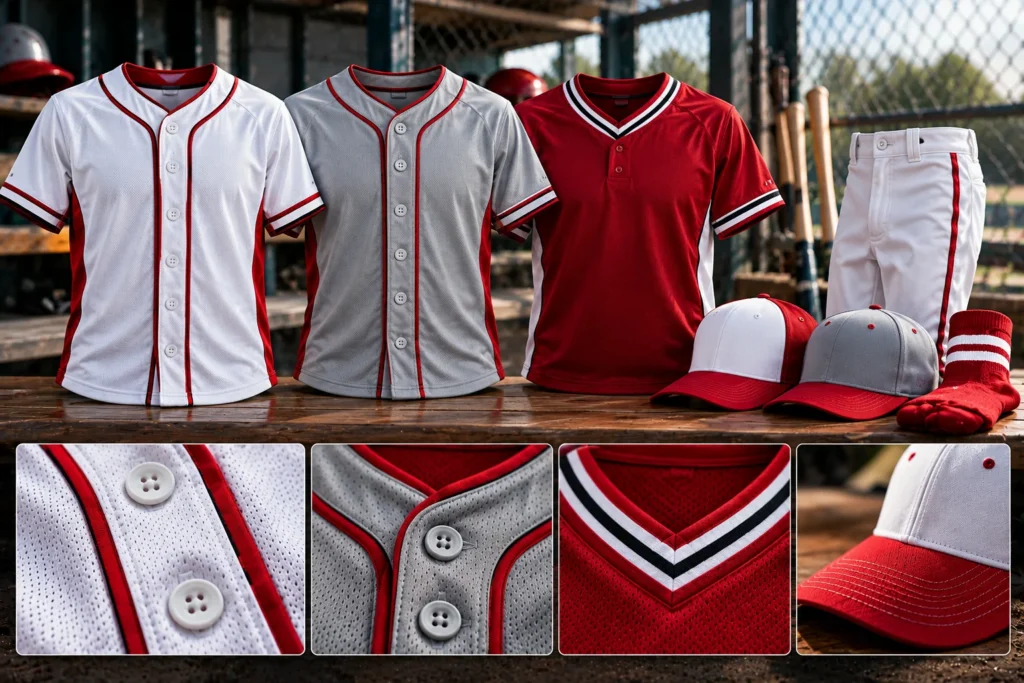
A jersey-only order and a full uniform order aren’t priced off the same base number, because pants, caps, and socks are separate line items, not add-ons folded into the jersey price. Ordering jerseys alone makes sense for replacing a handful of damaged pieces mid-season, adding a second colourway to a roster that already owns matching pants, or phasing a budget across a season. A full package ordered at once prices every item against the best combined quantity tier it can reach together, which usually beats pricing jerseys and pants separately at smaller volumes each.
Caps carry their own decoration cost worth knowing before you assume they’re a minor add-on: a structured cap logo runs 12,000 to 15,000 stitches on the same embroidery line, held to a 1 mm registration tolerance against your artwork. That’s real machine time per cap, priced the way it is for the same reason tackle twill is priced per character: it’s labor, not a markup.
MOQ 20 applies per jersey design, not per full team package, which is why a program ordering jerseys now and caps next month doesn’t lose anything by splitting the timing.
A club running Little League, a travel squad, and a high school varsity team doesn’t need each program to separately clear the 30-piece minimum. The total across every roster and colourway in one purchase order just needs to add up to 30, and full-button, two-button, and pullover styles combine toward that same number even when they’re different cuts for different age groups.
Each team’s artwork and dye lot still get archived on their own record, so pulling one team’s reorder next spring never drags another team’s spec into the conversation.
A quote request missing any of these turns into a round of questions instead of a same-day number:
The button you pick, how the design gets applied, and how many pieces ride together in one order do the real work on a baseball jersey’s price tag, artwork detail barely moves it. A travel squad dropping to two-button to protect its budget, or three age groups combining rosters to clear MOQ 20 in one purchase, are both examples of pulling one of those levers on purpose instead of waiting to see what a quote comes back with.
Browse the full baseball jersey line for construction detail on all three styles, or send your button style, decoration method, and full order composition now and get an exact quote back within 24 hours.