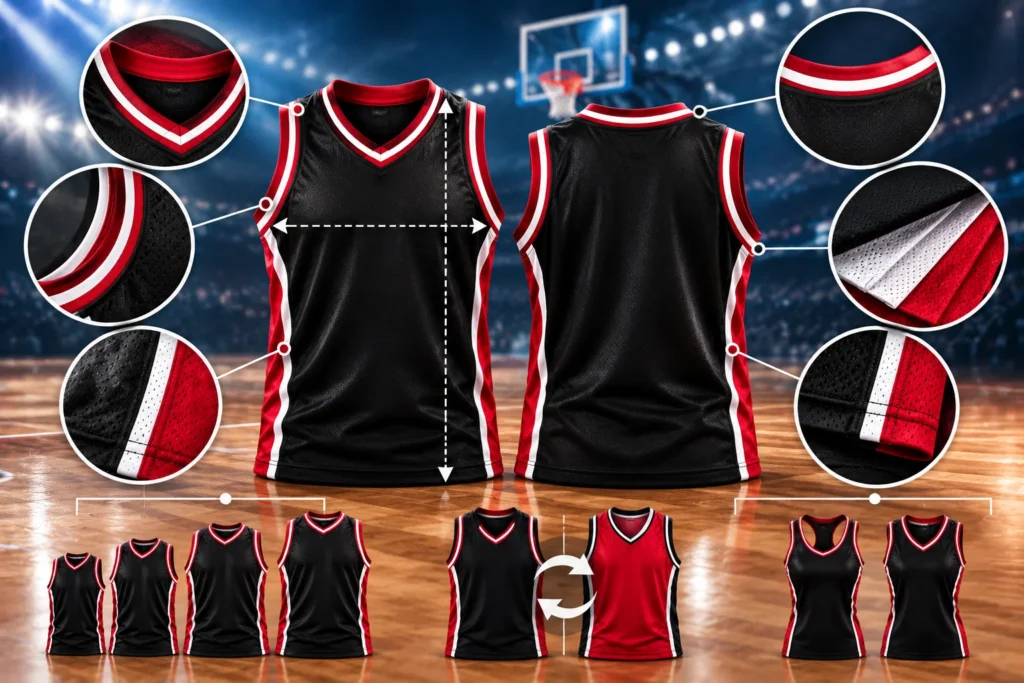
A basketball jersey doesn’t fit wrong because someone picked the wrong letter off a chart. It fits wrong because a size label means something different at every supplier, and two numbers, chest width and jersey length, are the only ones that actually travel between them. Measure those two off an existing jersey or the player directly, and the label stops mattering.
This matters more for basketball than most sports, because a basketball jersey has no waistband, no sleeve, and no fastener to compensate for a bad chest call. It’s one shape, worn loose, and either it clears the shoulders and reads right on the court or it doesn’t.
The rest of this guide walks through how to take those two measurements, why the same “Large” from two suppliers can differ by an inch or more, and where mixed rosters, reversible builds, and reorders each change the calculation.
A size label is a summary, and summaries lose information. “Large” tells a supplier nothing about whether that jersey runs 42 inches across the chest or 45. The two flat measurements underneath the label are what a cutting table actually works from, and they hold their meaning no matter whose jersey you’re comparing.
Between the two, chest width wins when a player’s measurements land between two sizes. A jersey that’s slightly long is barely noticeable in play. A jersey that’s tight across the chest restricts the reach and pivot that basketball actually demands.
The fastest and most reliable way to size a reorder or a new season isn’t a tape measure on a player at all, it’s a tape measure on a jersey that already fits well. Lay it flat on a hard, uncovered surface, smoothed out with no wrinkles and no stretch in the fabric, then take the chest and length measurements exactly as described above.
This works because a garment measurement and a body measurement aren’t the same number, and mixing them up is the single most common reason a team order comes back wrong. A body chest measurement includes the ease a jersey is supposed to add for movement. A garment measurement already has that ease built in. Send a body measurement labelled as a garment measurement, or the reverse, and the jersey that arrives fits nothing.
When there’s no existing jersey to reference, measure the player directly instead: relaxed posture, arms at the sides, tape level and snug but not tight, over light clothing rather than a hoodie or jacket. Either method gets to the same two numbers. What matters is knowing which one you’re sending.
A small amount of variance between the number on a spec sheet and the number on the finished jersey is normal in any cut-and-sew production run, fabric behaves slightly differently once it’s sublimated and pressed. That’s a reason to measure carefully once, not a reason to skip measuring and guess from a label instead.
“Large” carries no fixed chest-width meaning across the industry. One supplier’s Large might measure 42 inches across the chest, another’s 45, and a third might cut its whole range a half-size narrower because of how its pattern blocks are drafted. None of that is a defect, it’s just the reason a label alone is never enough information to reorder against.
Sending real chest-width and length numbers instead of a size name is what lets Rijiz Sports cut a jersey that matches the roster in front of you rather than a guess from someone else’s chart.
Ordering for a team that’s outgrown last year’s jerseys? Skip the size label entirely and send the chest-width and length numbers straight from this season’s roster. It’s the fastest way to a mockup and an exact quote back within 24 hours.
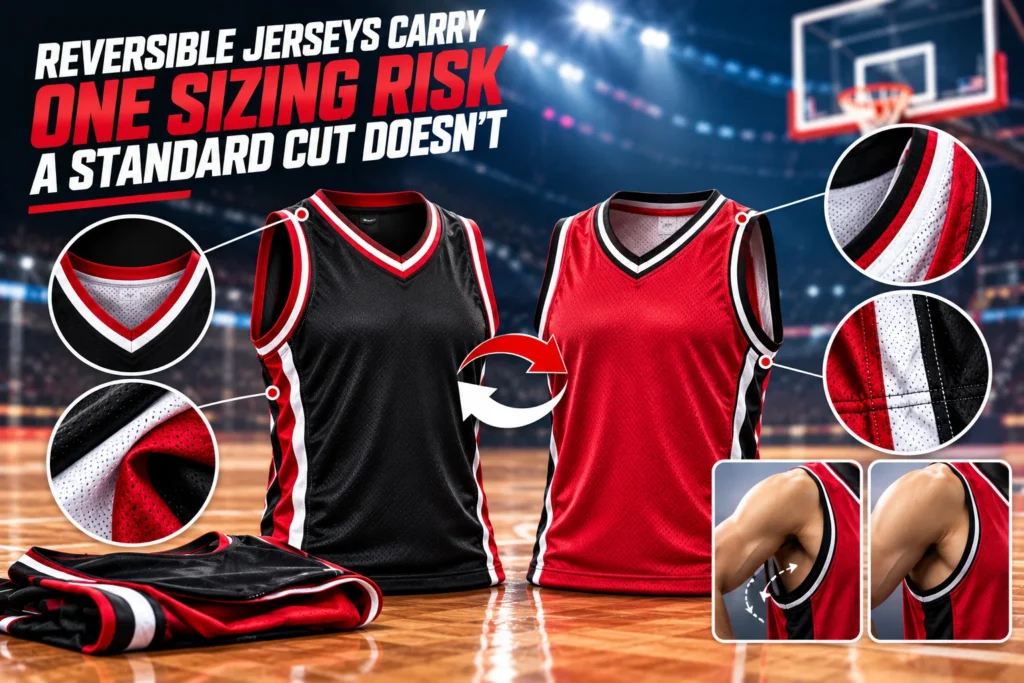
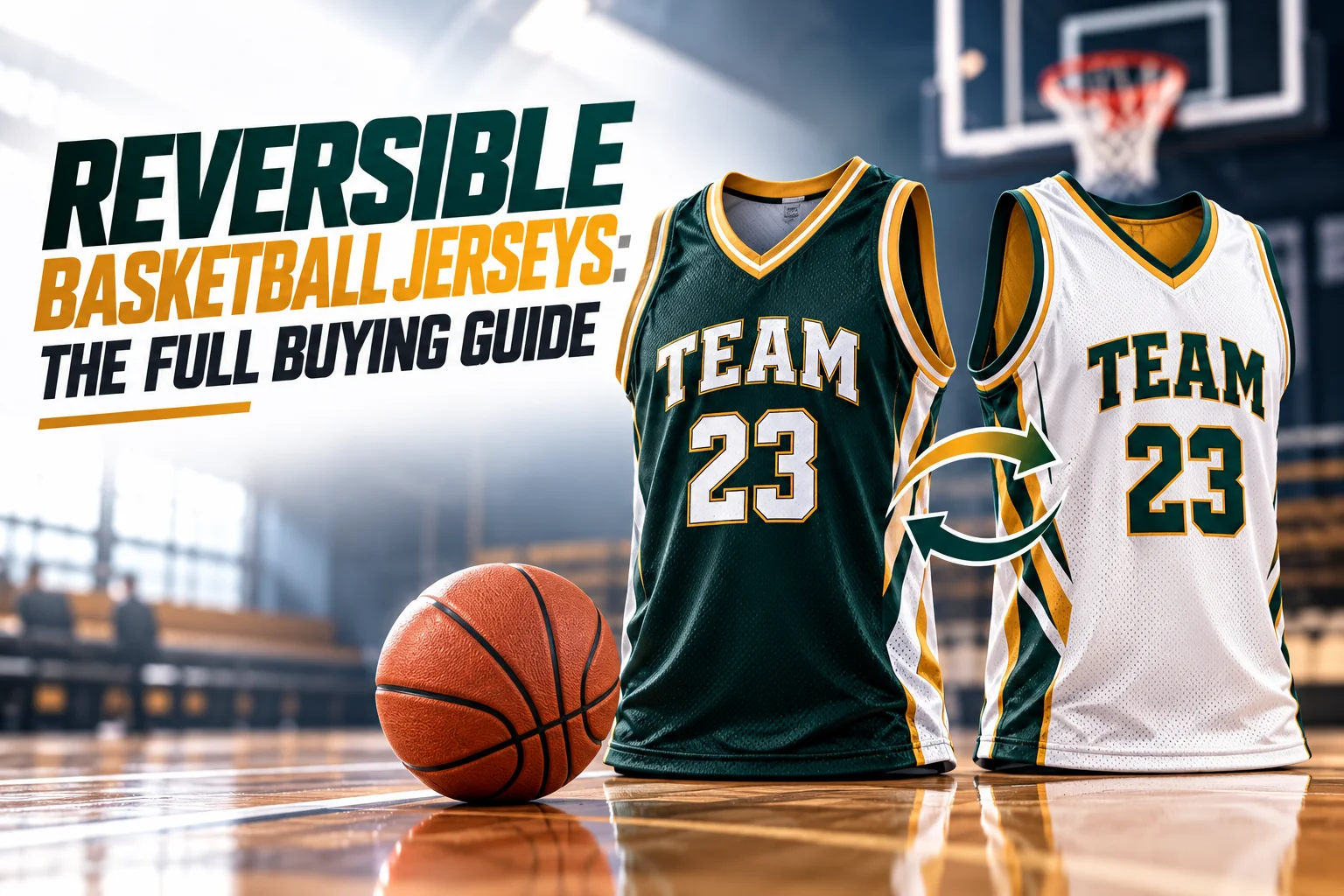
A sleeveless pullover forgives a slightly loose armhole. A reversible 2-in-1 jersey doesn’t, because the colour-transition seam runs directly through that same armhole area. Size the armhole too loose and a full reach can gap that seam open mid-game, exposing the inside layer at exactly the moment it shouldn’t show.
The fix isn’t a different measurement, it’s the same chest-width number taken carefully rather than rounded up “to be safe.” Reversible construction is genuinely double the fabric of a single-layer jersey, so there’s already less give in the armhole than a lighter cut has, and a size chosen a notch too big doesn’t just look loose, it changes how that seam behaves under contact. For the full construction and care picture, see our reversible basketball jersey guide.
If a roster is ordering reversible jerseys for the first time, comparing against an existing reversible garment (not a standard single-layer jersey) is worth the extra step, since the two cuts don’t measure identically at the same labeled size.
Chest width decides it. If a player’s chest measurement sits between two sizes but their length measurement matches the smaller size, go with the size that fits the chest and note the length separately, a body that’s slightly long on a jersey is a non-issue in play; a chest that’s tight across the shoulders isn’t.
For a growing youth player specifically, sizing up rather than down extends how many games a jersey gets worn before it’s outgrown, provided the larger size doesn’t distort the armhole placement enough to affect reach. For an adult player who wants a fitted, athletic cut rather than the traditional looser look, staying true to the measured size rather than rounding up keeps that intent intact.
Jersey length and decoration placement aren’t purely a fit decision once a league’s uniform rules get involved. High school programs playing under NFHS rules work within specific minimum number heights (4 inches on the front, 6 on the back) and armhole-trim limits, and those placement rules interact directly with how much clear torso space a chosen length actually leaves for the decoration.
Competitive leagues outside the US high-school system set their own equivalents, FIBA’s rules among them, so it’s worth confirming a league’s specific requirement before finalising length and decoration placement together rather than treating them as two separate decisions.
The reason chest and garment measurement get treated as two distinct things throughout this guide isn’t arbitrary either, ISO’s clothing size-designation standard exists specifically because a body measurement and a garment measurement describe two different things, and conflating them is exactly the mismatch that produces a wrong-fitting jersey.
A basketball jersey order goes wrong far more often from a mismatched size label than from a genuine fit problem. Chest width and jersey length, taken carefully from an existing jersey or directly from the roster, are the two numbers that actually decide how it turns out.
Send those measurements instead of a size guess, and Rijiz Sports builds the jersey to match the roster in front of you, with a mockup and an exact quote back within 24 hours.