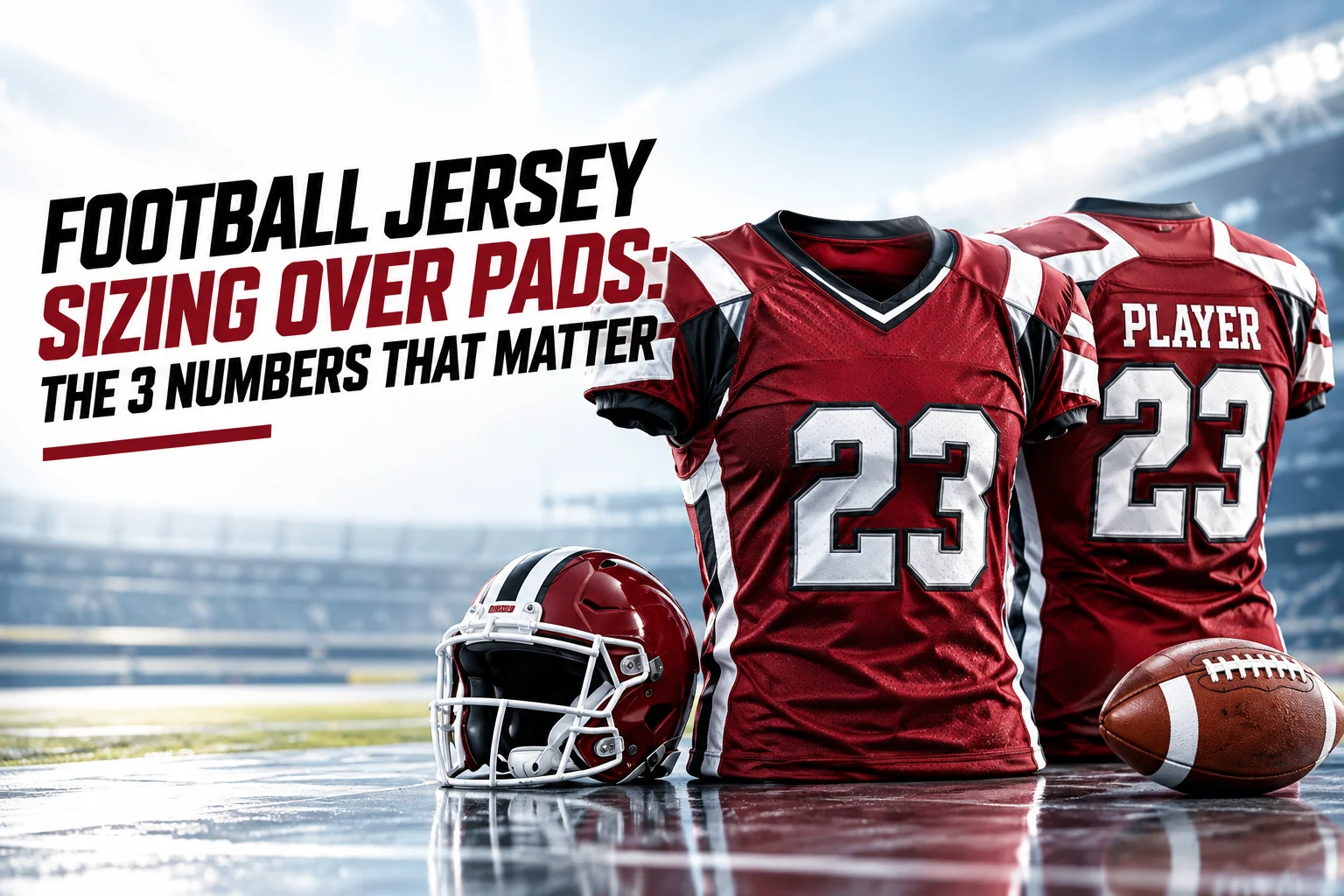
This is American football, not soccer, and the jersey has to clear a shoulder pad before it clears anything else. Four things decide what a football jersey actually costs: how much extra fabric the over-pad cut needs, how much of that fabric gets reinforced at contact points, how the jersey gets decorated, and whether you’re building for tackle or flag, since those two aren’t priced off the same jersey at all.
No other jersey on a roster has to fit over several inches of foam and plastic without binding, which is why football runs on a different set of levers than basketball or baseball. Knowing which of the four is pulling weight in your order is what turns a quote from a guess into arithmetic.
Below, each driver gets the same treatment our own factory floor gives it when pricing a real order, ending with exactly what a factory needs from you to send back a number instead of a range.
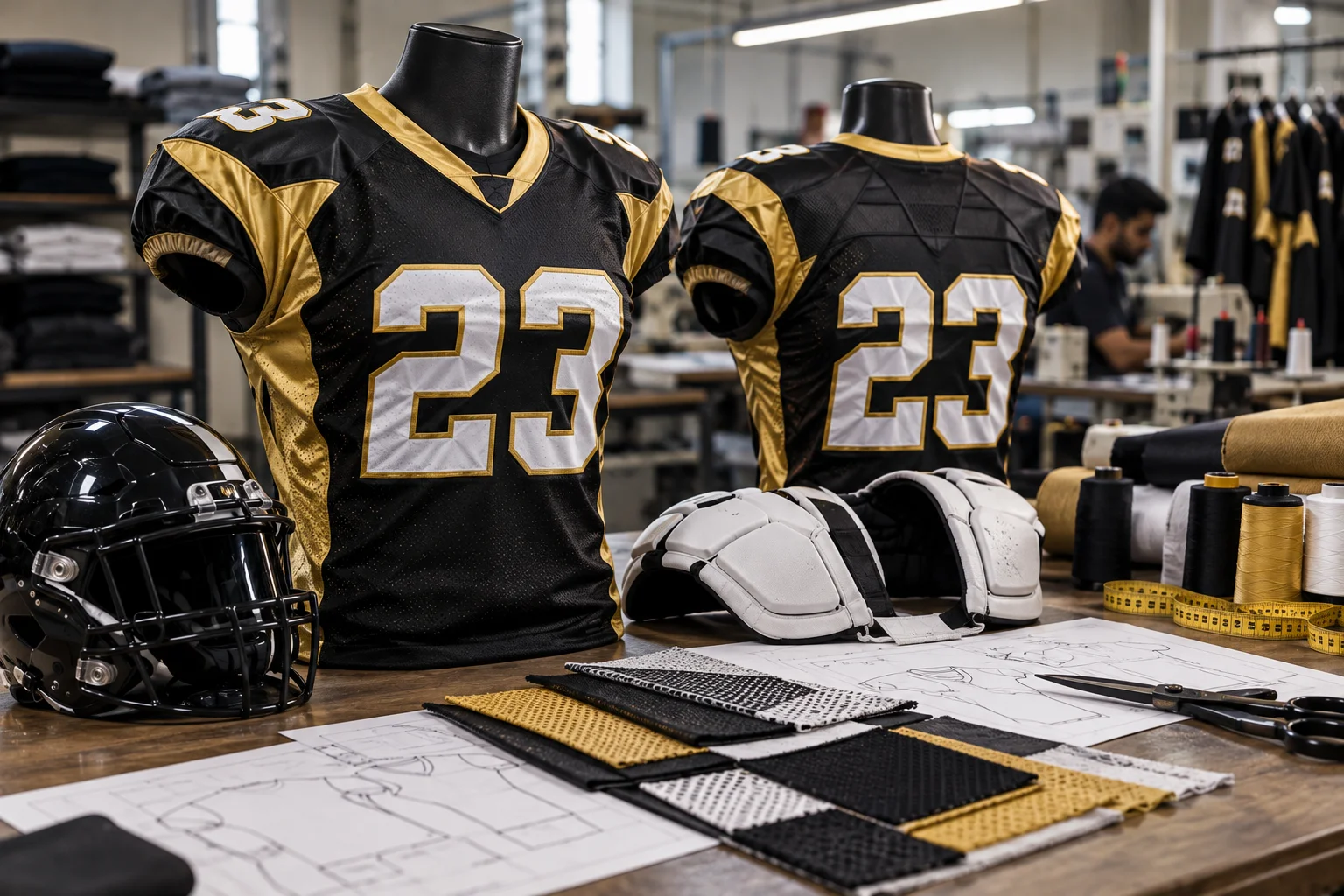
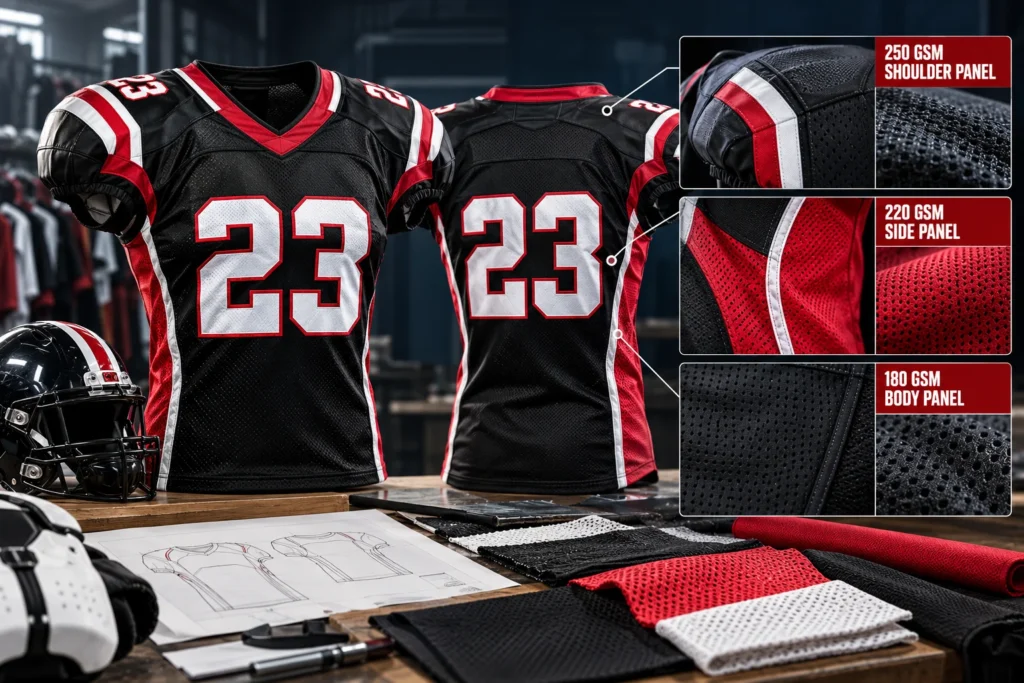
Every other jersey on this site is patterned to a bare torso. A football tackle jersey is patterned to a torso wearing several inches of shoulder pad, which means the shoulder and side panels have to run oversized with stretch built in, not just cut a size larger. That’s a different amount of fabric per jersey than a basketball or baseball pattern of the same weight uses, and it’s spent before a single logo goes on.
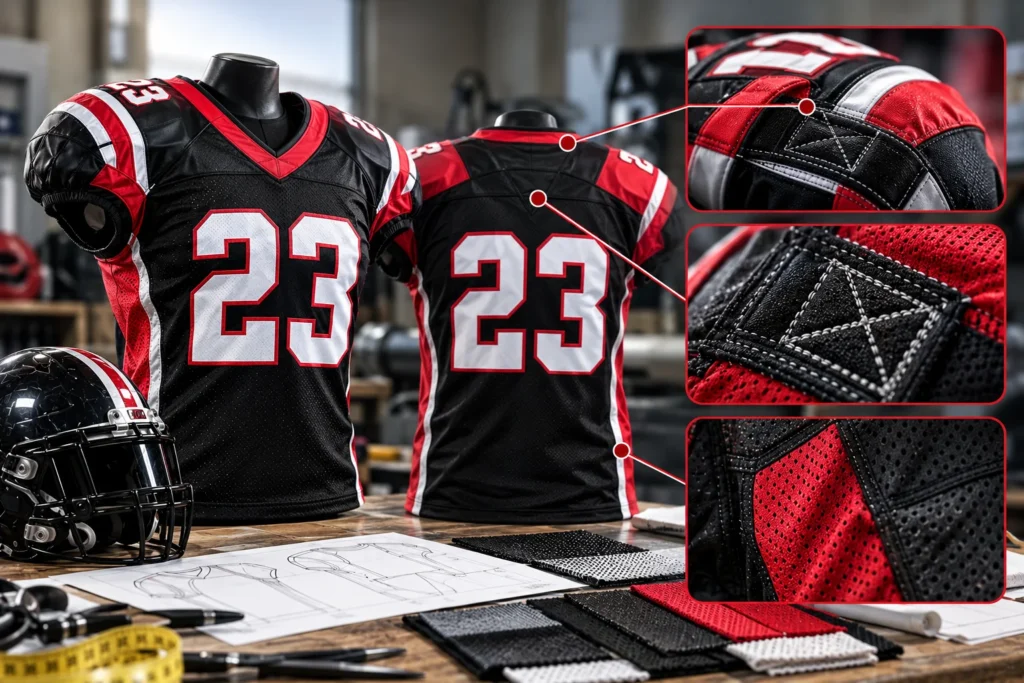
On our line that shows up as a three-panel system rather than one fabric across the whole jersey: a 250 GSM shoulder panel built to resist tearing from helmet straps and pad edges, a 220 GSM four-way stretch side panel that expands to let the athlete dress over pads and returns to shape afterward, and a 180 GSM open-weave body panel that vents heat during a drive. Pricing a tackle jersey means pricing all three panels and the extra pattern room the over-pad cut needs, not one number for “the fabric.”
A sleeve cuff has to clear the pad’s arm opening without riding up on a reach, and the torso has to stay long enough to tuck in under contact instead of pulling loose on the first hit. Both add pattern length that a bare-torso jersey never needs, which is fabric consumption tied directly to fit, not a styling choice a program can trim to save on the quote.
Competitors that mention football’s higher cost usually stop at “heavier fabric.” That’s only half of it. The shoulder panel on a tackle jersey needs a double-cowl reinforcement and bartack stitching at the stress points where helmet straps and pad edges make contact, and that’s cutting and sewing time on top of whatever the fabric itself costs. A factory pricing that reinforcement is pricing machine time, not marking up the material.
NFHS’s 2025 Football Jersey and Pant Rules require the jersey to completely cover the shoulder pads and any pad worn above the waist on the torso, which is exactly the coverage a factory is reinforcing for. Skipping that reinforcement to save on a quote isn’t actually an option for a jersey that has to pass that requirement on the field.
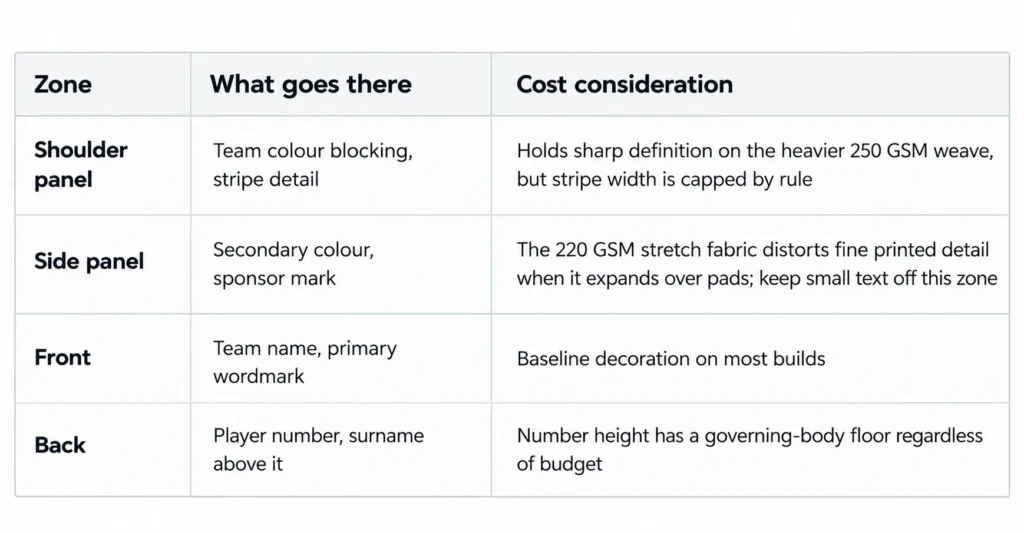
Sublimation prints a team name, numbers, and sponsor marks into the fabric at one flat rate regardless of colour count, because the design is dyed into the fabric in a single pass rather than applied per colour. Stitched twill numbers, cut from layered fabric and machine-stitched onto a printed base, price per character instead, since every letter is a separate piece of labor. Both fit over pads exactly the same way; the only difference is how the numbers get applied and what that costs.
Where the ceiling comes in is placement, not price. NFHS’s jersey rules cap a decorative side-seam insert at 4 inches wide and a shoulder stripe at 3.5 inches combined, and set the number height itself at a fixed minimum on front and back. A program can’t buy its way past those numbers by upgrading decoration, and a factory quoting a design that exceeds them is quoting a jersey that won’t pass inspection at the line of scrimmage.
Every other pricing question on this page assumes a tackle build. Flag isn’t a tackle jersey with the reinforcement left out to save money; it’s built on a lighter 160 GSM mesh with no pad allowance at all, since there’s no pad volume to leave room for. Sizing runs off a standard bare-chest measurement instead of the over-pads number the tackle section above walks through, and the reinforced shoulder and side-seam construction that drives tackle’s cost simply isn’t part of the flag build.
That means a flag quote isn’t a discounted tackle quote, it’s a different jersey on a different fabric spec from the start. A 7-on-7 passing-league jersey follows the same non-contact logic in a snugger, compression-cut build for spring and summer leagues, priced the same way flag is rather than as a lighter version of tackle.
A quote request missing any of these turns into a round of questions instead of a same-day answer:
Once Rijiz Sports has those five details, a real number comes back instead of a range, since none of the build is still guesswork by that point. An athletic department running tackle at the high school level and flag at the youth level can combine both into one purchase order too, since only the combined total across every roster has to clear MOQ 20, not each program separately. If your program also fields a baseball team, our baseball jersey pricing breakdown walks through the equivalent drivers for a button-front build.
A football jersey doesn’t compete with jerseys from other sports on price, since nothing else on a roster has to clear a shoulder pad. That’s the fact worth carrying into a quote: the over-pad cut, the reinforcement stitching, and whether the build is tackle or flag decide the number well before decoration does. Treating a flag order as a discounted tackle jersey, or guessing at bare-chest measurements instead of fitting over pads, is what turns a first order into a second, corrective one.
Send your build, pad-fit measurements, and decoration map, browse the full football jersey line for tackle, flag, and 7-on-7 detail, and get an exact quote back within 24 hours.