A goalkeeper jersey isn’t an outfield jersey with a bolder colour swapped in. It has to clear a colour rule the rest of the roster doesn’t, carry real padding at specific impact zones, and it gets ordered and quoted as its own line item, not folded into the outfield spec. Get any one of those three wrong and the jersey either fails inspection or lets a keeper down mid-dive.
This guide walks through what actually changes: the colour rule and where it comes from, what padding does and doesn’t cover, sleeve length, fabric, and how to size and order the build correctly the first time.
Under IFAB’s Law 4.3, the rule reads plainly: “Each goalkeeper must wear colours that are distinguishable from the other players and the match officials.” That single sentence, from the Laws of the Game, is why goalkeeper kits run in fluorescent green, orange, yellow, or a black that reads clearly against both teams’ colours rather than whatever shade a club’s outfield kit happens to use.
The rule checks against four things at once: your own team’s kit, the opponent’s kit, the away goalkeeper’s kit, and the match officials’ kit. A goalkeeper colour that clears your own roster can still fail if it lands too close to the referee’s shirt or the opposing keeper’s.
The Laws include a built-in exception: “If the two goalkeepers’ shirts are the same colour and neither has another shirt, the referee allows the match to be played.” That’s a fallback for a genuine conflict on match day, not a reason to skip ordering a second colourway. A club that carries only one goalkeeper colour is betting on the opposing keeper never showing up in the same shade.
NFHS, which governs US high school soccer, states in its own uniform reference sheet: “GOALKEEPER’S jersey must be distinctly different in color from that of team members and the opposing team.” It goes further than IFAB by also requiring every jersey, including the goalkeeper’s, to carry a front number at least 4 inches tall and a back number at least 6 inches tall, in a colour that contrasts against the jersey. A goalkeeper jersey that clears the colour rule but skips a compliant number still won’t pass a check-in.
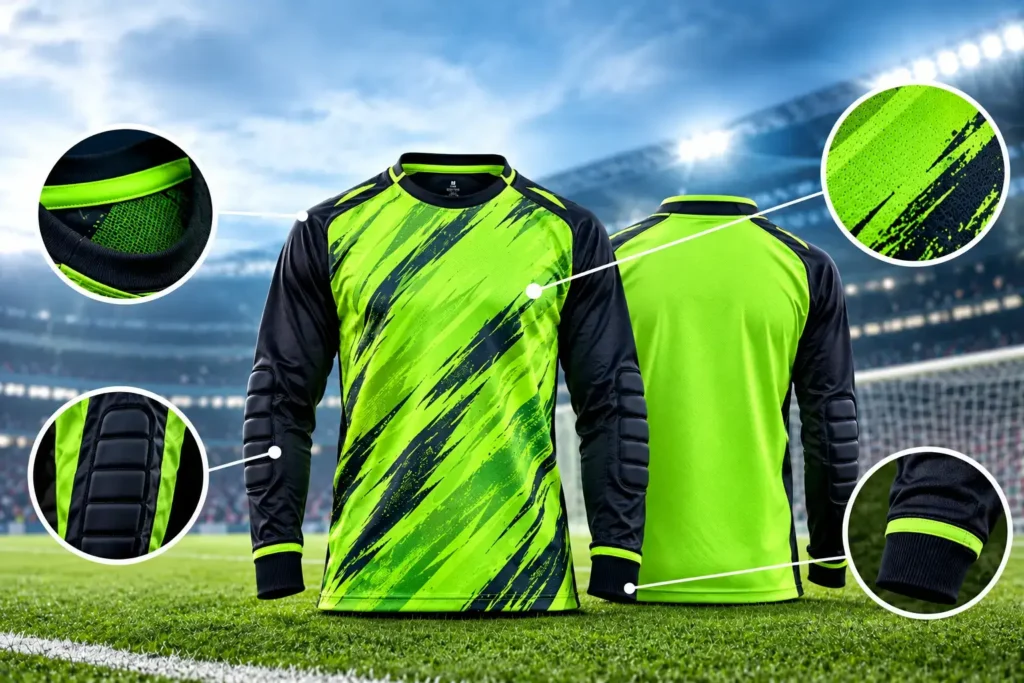
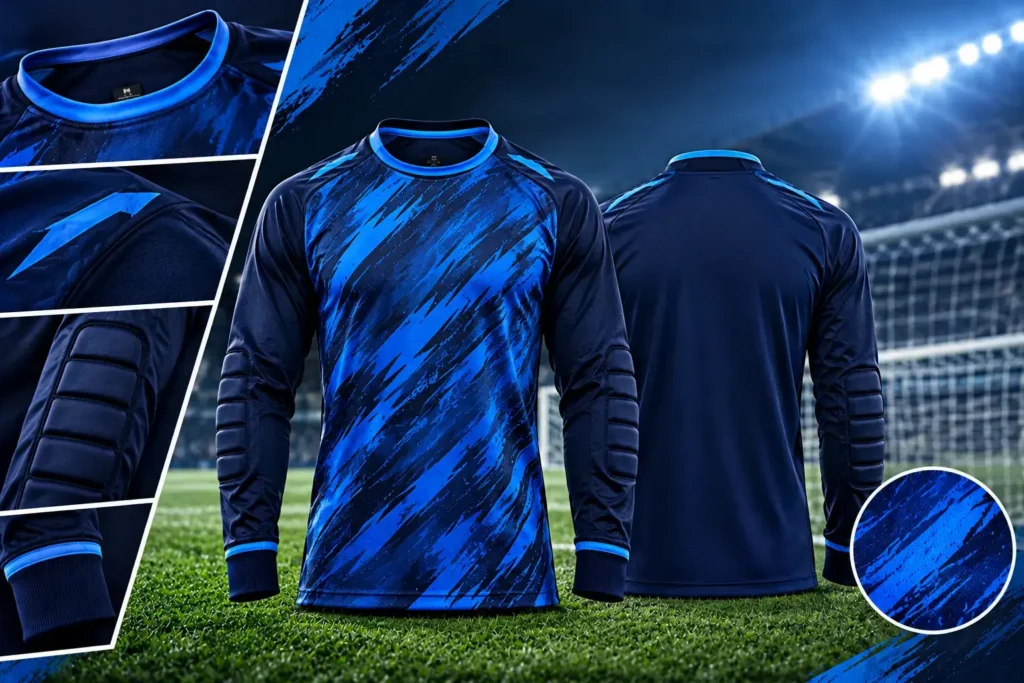
The most common mistake a program makes is treating the goalkeeper jersey as the outfield design with a heavier colourway. It isn’t. Our goalkeeper build carries 8mm EVA foam at the elbows and hips, foam sewn into the panel, not an image of padding sublimated onto flat fabric. A keeper who dives onto a printed graphic finds out the difference the moment they hit the ground.
Padding sits specifically where a keeper makes repeated ground contact, the elbows and hips, alongside heavier, abrasion-resistant fabric across the chest and sides where a dive drags against turf or a hard pitch. None of the competitor product pages we reviewed name a foam type or thickness; most either sell arm padding as a separate accessory or mention “padded elbows” without specifying what’s inside the panel.
Wash care matters here too: wringing or twisting the padded zones compresses the EVA foam over time and reduces its cushioning, so a goalkeeper jersey needs the same cold-wash, no-wring routine as the rest of the kit, with extra attention paid to those two panels specifically.
Nothing in the Laws of the Game requires a goalkeeper to wear long sleeves. Law 4.2 only requires “a shirt with sleeves” for every player, goalkeeper included, without specifying a length. Short-sleeve goalkeeper builds are legal and common in warm-weather competition.
Long sleeves earn their popularity from what they cover, not from a rule. A padded long sleeve protects more forearm and elbow surface during a dive across turf, which is why most competitive goalkeeper jerseys default to long sleeve even though a short-sleeve build clears every requirement. The choice comes down to climate, playing surface, and personal preference, the same factors that decide crew, V-neck, or Henley collar on an outfield jersey.
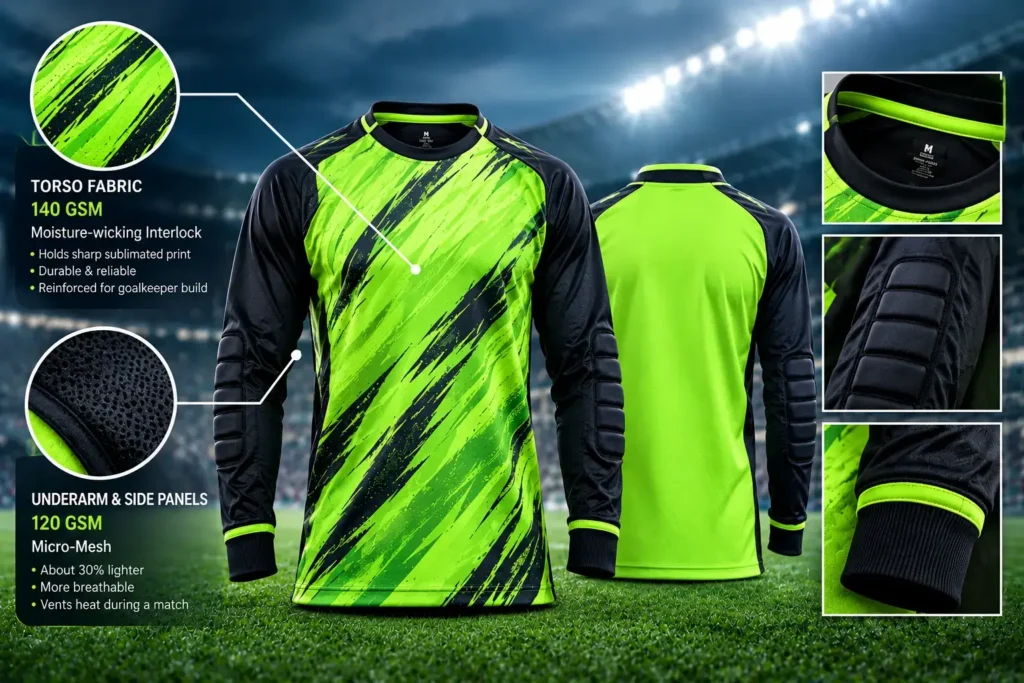
A single fabric weight across the whole jersey is cheaper to cut but wrong for either half of the build. The torso runs in 140 GSM moisture-wicking interlock, dense enough to hold a sharp sublimated print and to take the reinforced construction a goalkeeper needs across the chest and sides. The underarm and side panels run in 120 GSM micro-mesh, about 30% lighter than the interlock body, open enough to vent the two zones that generate the most heat during a match.
That zoning is the same two-fabric build used across the outfield jersey, but on a goalkeeper cut it does more work: the heavier interlock is also where the reinforcement against turf contact sits, not just where the print needs to stay sharp.
The build difference means the ordering has to follow suit. List the goalkeeper jersey as its own line item on the tech pack instead of assuming your outfield spec covers it with a colour swap. That’s true whether you’re outfitting one keeper on a youth roster or a full academy running multiple goalkeeper kits across age groups.
MOQ 20 applies per design, but it doesn’t mean a program with two or three keepers on the whole roster is stuck ordering 30 identical goalkeeper jerseys to hit the minimum. Different squads, styles, and sizes within one combined purchase order count toward the same total, so a club ordering outfield jerseys, goalkeeper jerseys, and youth sizes together still only needs the combined order to clear 30. What actually drives the number on your invoice is a separate question. Goalkeeper construction is one of the real cost factors in a soccer jersey quote, alongside decoration coverage and quantity tier.
A goalkeeper jersey should measure longer from shoulder seam to hem than the outfield cut in the same size, extra coverage for the torso during a full-stretch dive. Chest width still measures the same way, across the widest point of the torso, but treat the length number as a separate spec rather than assuming the outfield chart applies unchanged.
Send real measurements against a jersey your current keeper wears well, rather than a size label alone. A label means something different at every supplier, and a goalkeeper jersey that runs short through the body defeats the coverage the extra length was built to provide. The same chest-and-length discipline our basketball jersey sizing guide walks through for skipping the size label entirely applies here too, just with the extra torso allowance a dive needs.