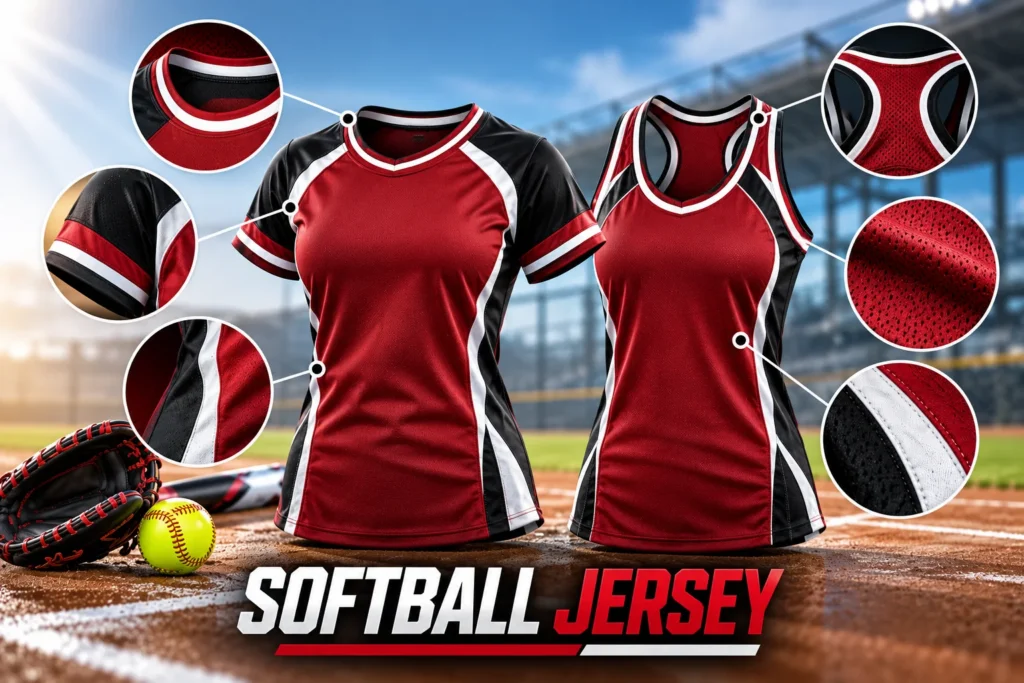
A softball jersey’s price starts with a decision most buyers make before they ever request a quote: racerback for fastpitch, or crewneck for slowpitch. Those aren’t two collar options on the same garment, they’re two separate patterns built for two different games, and that choice moves the number more than anything decorated onto the jersey afterward.
From there, how much of the jersey carries print or stitched lettering, and how many pieces the order covers once every division is counted, do the rest of the work. A travel program and a co-ed rec league can send what looks like the same order on paper and land on two different numbers, and the gap almost always traces back to the cut, not a supplier padding the quote.
This walks through each driver the way our own softball jersey line prices it on our own factory floor, then shows exactly what to send to get an exact number back within 24 hours, not a guess.
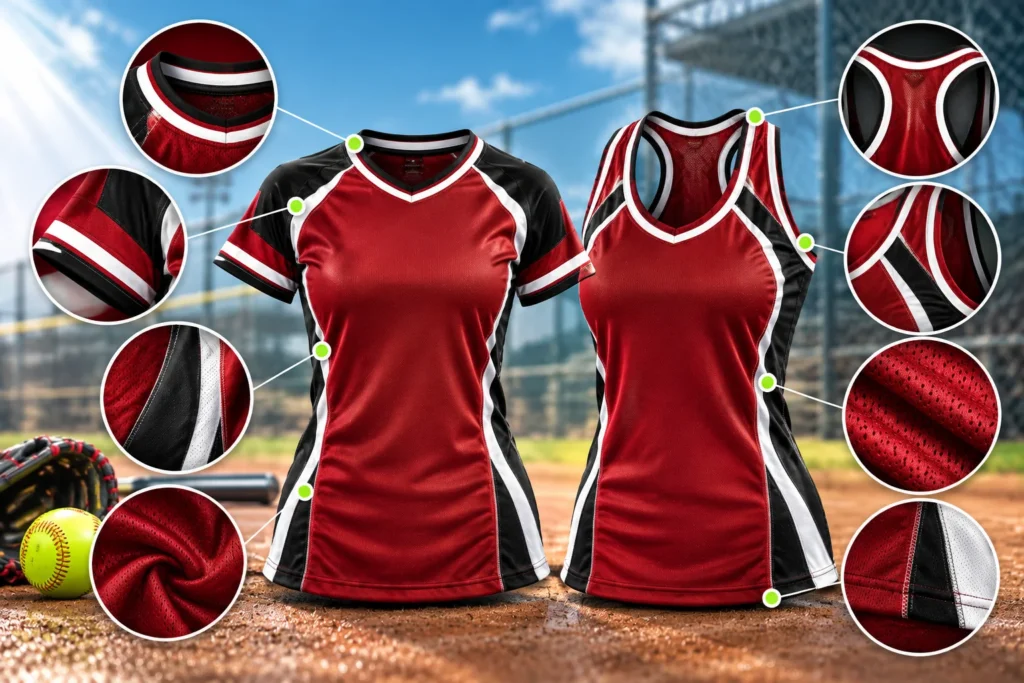
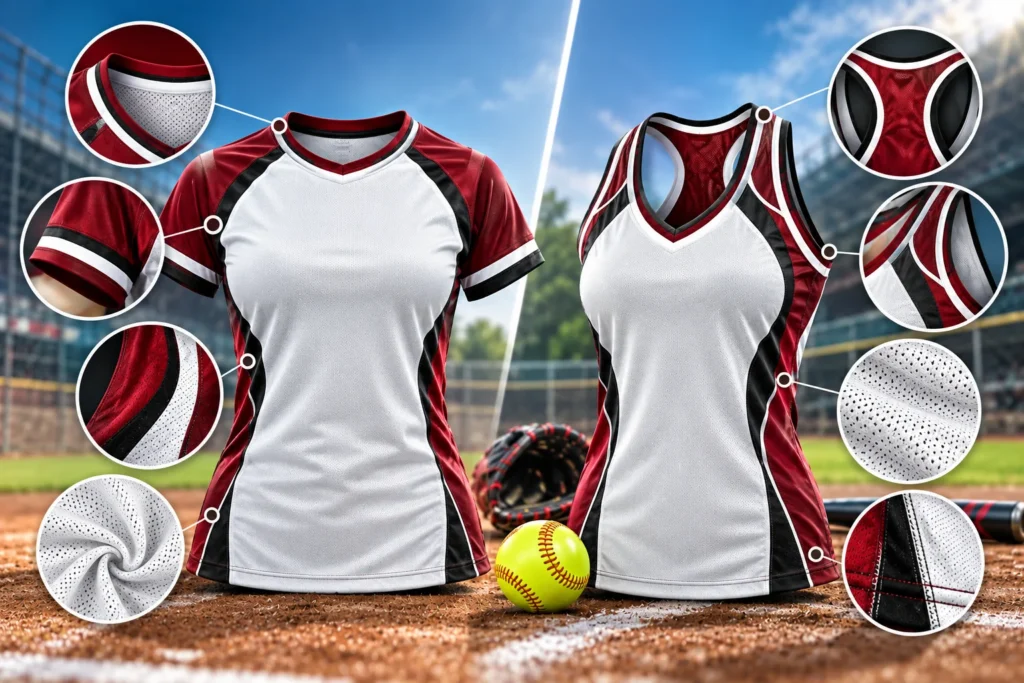
A fastpitch pitcher’s throwing shoulder rotates through a full windmill arc on every delivery, a motion a set-in sleeve was never built to clear. That’s why a racerback fastpitch jersey runs sleeveless with an open armhole and a back panel cut shoulder-blade to shoulder-blade with no centre seam, on 170 GSM bird eye mesh chosen for airflow during a full game of that motion. A slowpitch crewneck jersey solves a different problem entirely: a longer, lower-intensity format played by a wider range of body types, so it runs looser through the chest and shoulders, short or long sleeve, on 150 GSM interlock chosen for durability over a longer season.
Cutting and assembling the racerback’s seamless back panel is more labour than sewing a standard crewneck body, which is the real reason racerback prices toward the top of its range and crewneck typically prices toward the bottom, not a markup on the sleeveless look. A GSM figure itself isn’t a marketing number either. It’s tested mass per unit area under ASTM D3776, the same standard whether the fabric is a knit mesh or an interlock, which is why “140 GSM” means the same thing regardless of which supplier states it.
A club fielding a competitive travel roster and a house-league slowpitch team isn’t ordering the same jersey in two sizes of enthusiasm. They’re two different builds solving two different problems, and treating them as interchangeable is what leads to a racerback jersey binding mid-windup or a crewneck running too fitted for a rec-league body range. Specifying which format each roster plays, not just which colours, is what keeps a quote accurate the first time.
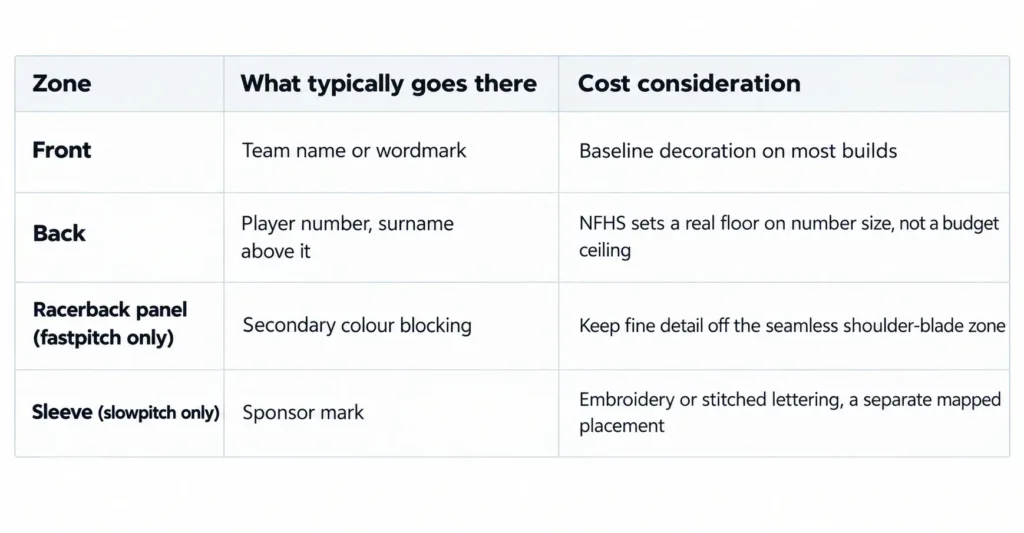
Sublimation dyes a design into the fabric in one pass, so a fourth or fifth colour in a team name or sponsor mark doesn’t add a production step the way it would with screen printing. What does move the number is how much surface gets decorated and where, since a front wordmark and back number is a different job than full colour blocking across the racerback panel or a sponsor mark stitched onto a slowpitch sleeve.
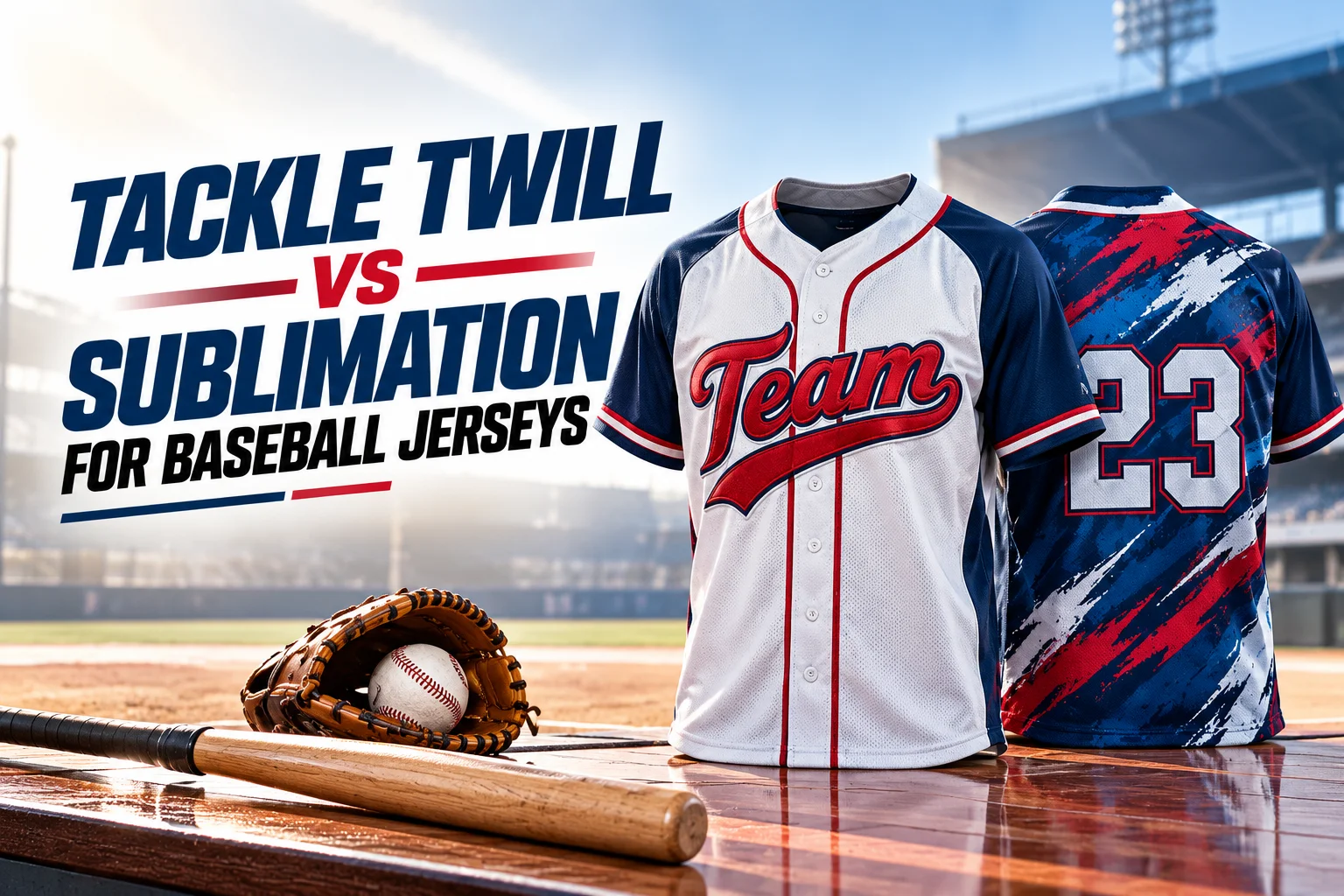
NFHS’s softball uniform rules require a back number at least 6 inches high in a solid colour contrasting with the shirt, and cap a manufacturer’s logo at 2.25 square inches per item. Neither of those is a factory upcharge; they’re a rulebook floor and ceiling a design has to clear before it clears cost, for sanctioned play at any budget. Most programs order a sublimated body with stitched twill names and numbers rather than an all-print jersey, since the raised, dimensional lettering holds through a full season the same way whether the body underneath is racerback or crewneck. For the full comparison of when stitched twill earns its extra step over straight sublimation, see our tackle twill vs. sublimation guide, which applies the same mechanism to softball’s decoration choice.
Cutting a racerback or crewneck pattern and prepping a sublimation run cost a factory roughly the same amount of time whether the order covers 20 jerseys or 300. That fixed setup cost gets divided across every piece in the order, which is why MOQ 20 per design is the floor a quote works from rather than an arbitrary policy number. Below that quantity, the fixed cost per piece stops making sense to price against.
An association running a fastpitch travel squad, a house-league slowpitch team, and a rec division under one badge doesn’t need each group to separately clear 20 pieces. Colours, cut, and size breakdown can differ division by division inside one combined purchase order, as long as the total across every design in that order reaches 20. Each division’s artwork and dye lot still get archived on its own record, so pulling one team’s reorder next season never touches another team’s spec.
A quote request missing any of these turns into a round of questions instead of a same-day answer:
Cut, decoration placement, and order volume are the three levers doing the real work on a softball jersey’s price tag, a loud design or a busy colourway barely moves the number either way. A travel program specifying racerback for its competitive roster while a rec division runs crewneck under the same purchase order is pulling exactly the levers this page walks through, on purpose, instead of waiting to see what a quote comes back with.
Browse the full softball jersey line for construction detail on both cuts, or send your cut, decoration map, and quantity now and get an exact quote back within 24 hours.