A basketball jersey’s price comes down to three things a factory has to account for before it can quote you: how much fabric the build actually uses, how much of the jersey gets decorated, and how many pieces you’re ordering. Nothing else on the jersey moves the number the way those three do, not colour count, not artwork complexity.
That’s true whether you’re comparing a sleeveless pullover against a reversible 2-in-1, or trying to work out why one supplier’s number looks nothing like another’s for what reads as the same jersey on paper. Once you know which lever is doing the work, a quote stops being a mystery and starts being something you can plan around before you ever fill out a form.
This breaks down each driver the way our own basketball jersey line prices it, factory-direct, then shows you what to send to get an exact number back, not a ballpark.
A reversible 2-in-1 jersey is built from two full layers of fabric joined at the seams, not one layer with a second colour printed on the back. On our line that’s roughly 260 GSM total fabric weight in a reversible build against 140 GSM for a single-layer sleeveless jersey, close to double. A factory pricing a reversible order is pricing double the fabric, double the cutting, and a second decoration pass on the reverse side, and that cost shows up in the quote whether the buyer asked for it explicitly or not.
That’s also why reversible is the wrong build for every roster. If your team only ever wears one colourway, a reversible jersey’s added fabric and construction cost is paying for a feature nobody uses. It earns its cost back for squads playing multiple neutral-site games in a single weekend, where packing one reversible kit replaces packing two full sets of jerseys. For the construction, weight, and care detail, see our reversible basketball jersey guide.
A full-button warm-up isn’t priced against the same baseline as a game jersey, even on the same order. It’s worn over a compression layer or t-shirt rather than against skin, so the fabric spec and button-front construction change the build cost independently of anything happening with the game jersey it’s ordered alongside. Treat it as its own line item when you’re estimating a season’s total, not a rounding error on the jersey price.
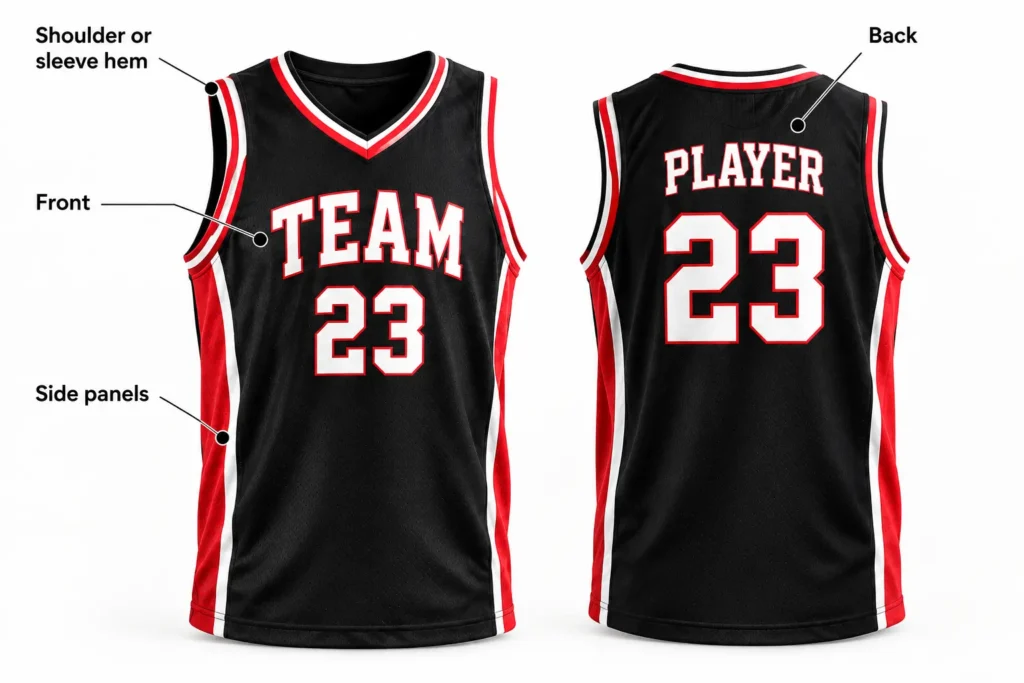
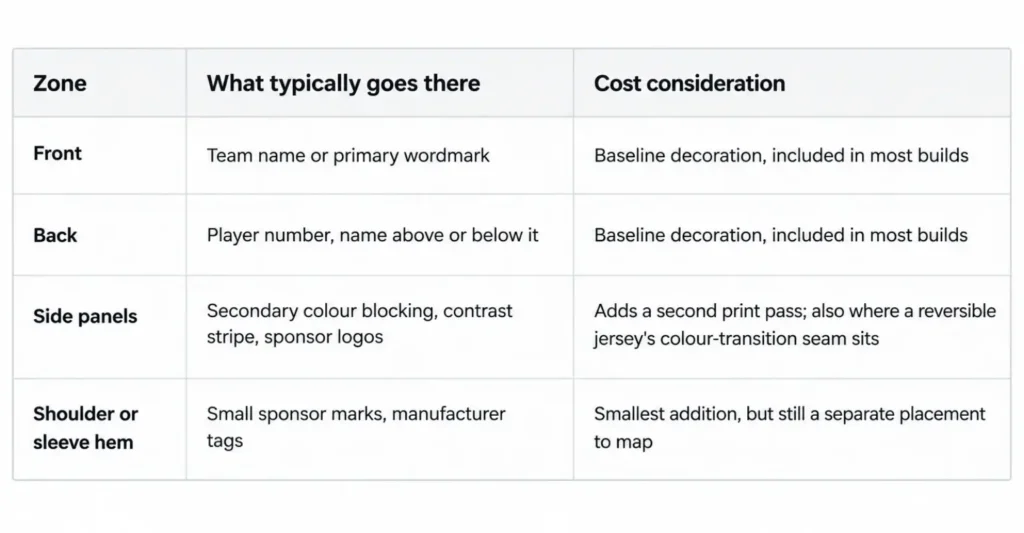
Sublimation prints are dyed into the fabric during production, so adding a fourth or fifth colour to a design doesn’t add a production step the way it does with screen printing. What does add cost is how much of the jersey’s surface gets decorated and where. A front wordmark and back number is one thing; full-front colour blocking, side-panel graphics, and sponsor placement across multiple zones is a different production job, even if the colour count is identical.
Fine text and small logos come with their own constraint on eyelet mesh specifically: anything under about a quarter-inch tall doesn’t reproduce cleanly through the fabric’s pinhole structure. Moving small sponsor text to a smooth panel instead of directly over mesh avoids a tech pack revision cycle that costs you time even when it doesn’t add a line item to the quote.
Governing bodies also set a floor under how small a back number can go regardless of budget. FIBA’s Official Basketball Rules publish equipment specifications as their own document alongside the playing rules, which is why shrinking a back number to save print area isn’t actually an available way to cut decoration cost for competitive play, it has to clear the size your league or federation sets first.
Cutting a pattern, prepping a sublimation print run, and setting up a production line take roughly the same amount of factory time whether you’re producing 30 jerseys or 300. That fixed setup cost gets spread across every piece in the order, which is why per-piece pricing improves as quantity increases and why MOQ 30 per design is the floor rather than a policy. Below that quantity, the fixed cost per piece stops making sense for either side of the order.
Multi-team programs don’t need to clear MOQ 30 per team individually. Varsity, JV, and a feeder program can each run their own colours and sizes within a single combined purchase order, as long as the total across every design in that order clears 30 pieces. Each team’s spec still gets archived separately, so a reorder next season matches what shipped this season without re-specifying anything.
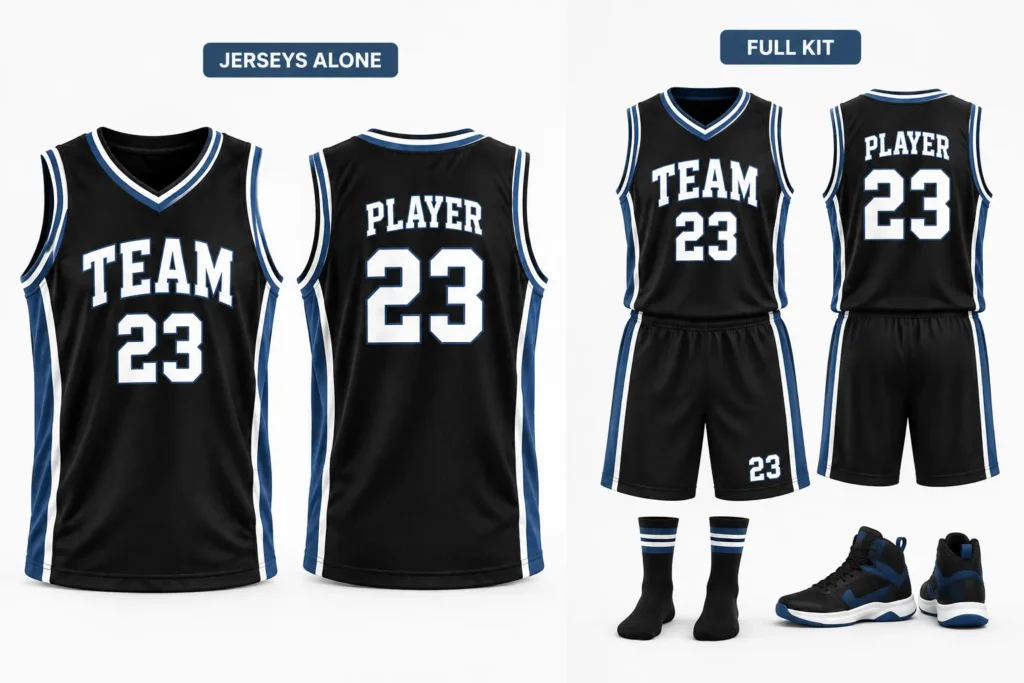
Ordering jerseys without shorts, socks, or warm-ups makes sense for replacing damaged pieces mid-season, adding a second colourway to a roster that already has matching shorts, or phasing a budget across a season. A full kit ordered at once prices every item against the best combined quantity tier it can reach together, rather than pricing jerseys and shorts against separate, smaller tiers. Which approach costs less depends on what you’re actually outfitting, not a blanket rule either way.
A quote request that skips any of these turns into a back-and-forth instead of a same-day answer:
Reversible construction, decoration coverage, and quantity tier are the three things actually setting your price, everything else is a detail layered on top of those three. Once you know which lever you’re pulling, whether that’s choosing single-layer over reversible for a roster that only wears one colourway, or combining a multi-team order to clear MOQ 30 as one purchase, you can plan a budget before a single number comes back.
Explore the full basketball jersey line for style details, or send your style, quantity, and decoration map now and get an exact quote back within 24 hours.